May '68: Politics and History (2022)
This is the fourth chapter of Chronologies du présent, a collection of essays published in 2022 based on a series of lectures given by Sylvain Lazarus in 2018. Crisis and Critique published other excerpts in “Subjective Singularities”, including the Introduction by Claire Nioche, the first lecture on “The Two Classisms”, the fifth chapter on the titular “Subjective Singularities”, and the Conclusion on “The Subjective Without Organization”. We have also published the third chapter, “Timelines: The Two Arcs”, in this issue, alongside an introduction to both chapters.
Does a great eventality1 (événementialité) invite new benchmarks in the personal realm of the political decision? Politics as thought is a decision. We are thrown into the fray from the outset. The category of decision implies courage and the question of meaning: both principle and conviction in action.
The years preceding 1968 were marked by the spread of guerrilla warfare in Latin America, the Chinese Cultural Revolution, the African American uprising in the United States, and, in many countries, the revolt of the youth. In January 1968, the Tet Offensive took place in Saigon. In terms of global public opinion, the Vietnamese people’s victorious resistance played a significant role. For many, the Vietnamese war against the United States, the world’s premier military and economic power, was an inspiring lesson for all peoples. The Soviets, unlike the Chinese, offered to act as peace negotiators in Vietnam, persuaded that peace would be possible only under their aegis and that of the Americans. On the contrary, the Chinese maintained that “the people’s war is invincible,” and that “a small people relying on its own strength can defeat a great one.” This conjuncture marked the atmosphere of May 1968.
I would like to specify what made the workers’ phase of the Chinese Cultural Revolution an inspiration to some of us, myself included. This was the renewed possibility of a workers’ initiative, the return of the proletarian class struggle. It enabled us to close the door on Stalinism and to respond to the revisionist arrogance of the USSR. The significance for us, militants, of this workers’ sequence of the Cultural Revolution also lies in its liberating power from the dictatorship of the PCF and the CGT. It was even the possibility, some thought for a brief moment, of a proletarian syndicalism, against the syndicalism monopolized by the CGT.2 In other words, it was the hope for a return to the proletarian class struggle, which the PCF had abandoned.
Our relationship to the Chinese revolutionary experience has gone through successive phases. The initial event was the Sino-Soviet split in 1960: this schism within the international communist movement created a new situation in which there were multiple state and ideological paths to communism. This put an end to the arrogant and terrorist centrality of Soviet hegemony.
There was a key moment, a foreshadowing moment, that I have often returned to: in the People’s Republic of China, in the 1950s, a debate over military policy opposed Peng Dehuai, who affirmed that the Chinese Red Army should be modeled after the Soviet Army, to Mao and Lin Biao, who supported that the Red Army should be a people’s army for national defense. This debate was linked to crucial choices regarding industry; should it be indexed to the production of war materials (tanks, aircraft, battleships...) or to agriculture? The Sino-Soviet split thus centered on the construction of socialism from an ideological standpoint: counting on one’s own strength, counting on the inventiveness of the masses, and continuing the class struggle within socialism, including within the Communist Party.
The split in the international communist movement had, as I said, a liberating effect on the PCF and the CGT, which were openly criticized and rejected. Initially, this translated into a return to Marxism-Leninism, following the example of the Chinese, who, criticizing Khrushchev’s revisionism and his policy of peaceful coexistence with the U.S., charged him with abandoning Marxism-Leninism.3 Thus, in France, the first phase of the Sino-Soviet split was that of Marxism-Leninism, distinct from the phase that would follow, that of Maoism properly speaking. The Union of Communist Youth (Marxist-Leninist), the UJC(ml), was created at the end of 1966. It advocated for an authentic, antagonistic class struggle, pitting the proletariat against the bourgeoisie and the bourgeois state. The major criticism leveled at the PCF and the CGT was that they had renounced the proletarian class struggle by abandoning the dictatorship of the proletariat in favor of a peaceful transition to socialism, announced as early as 1946.4
Among the UJC(ml)’s initiatives, I would highlight four: the formation in Marxism-Leninism, notably through the publication of Cahiers marxistes-léninistes5, a theoretical review; the launch of a broad militant investigation in rural areas by going to work with poor peasants; the politics of l'établissement6 (student militants working in factories to organize the workers); and a declared anti-imperialist line with the creation of the grassroots Vietnam Base Committees7 in 1967, highlighting the Vietnamese slogans: “Rely on one’s own strength,” “A small people can defeat a great one,” “The determination to win decides everything.” With the grassroots Vietnam Base Committees, a mass style took shape that would gradually find its base as 1968 approached, and especially after 1968, in Maoism. Maoism in France and what are known as the Maos represent, in my view, a singular style of mass militant work, one that is very active, very aggressive, and very ideological: the mass line was a fundamental category of Maoism. It is a new figure of militants that would find its confirmation in the spirit and inspiration of the great mobilizations of 1968.
In fact, the international context and the national liberation struggles revived and renewed the space of proletarian internationalism, what I called at the time a ”new global ideological history.” It was the hope for a new internationalism following the end of the Third International. In France in particular, there was a refusal and indignation among progressive youth in the face of the PCF’s total alignment with Soviet policy. For the intellectual youth, these questions were at the forefront. Could Marxism and Leninism be saved from Stalinism, and then from revisionism? Althusser, for his part, proposed rethinking Marxism after Stalinism, but while remaining in the PCF and, in my view, sacrificing the Leninist rupture.
The situation in France was marked from the beginning of 1968 by workers’ strikes that led to clashes with the police, as well as a large-scale and prolonged student mobilization, particularly at the University of Nanterre.8 Extremely violent clashes broke out between far-left and far-right groups, in universities and in the street.
In April, in Paris, at 44 Rue de Rennes, across from Saint-Germain Church, an exhibition in support of the Vietnamese puppet regime was organized by Occident, a far-right organization; the Vietnam Base Committees stormed the venue and ransacked it. In response, Occident activists decided they would take revenge, particularly in Nanterre.
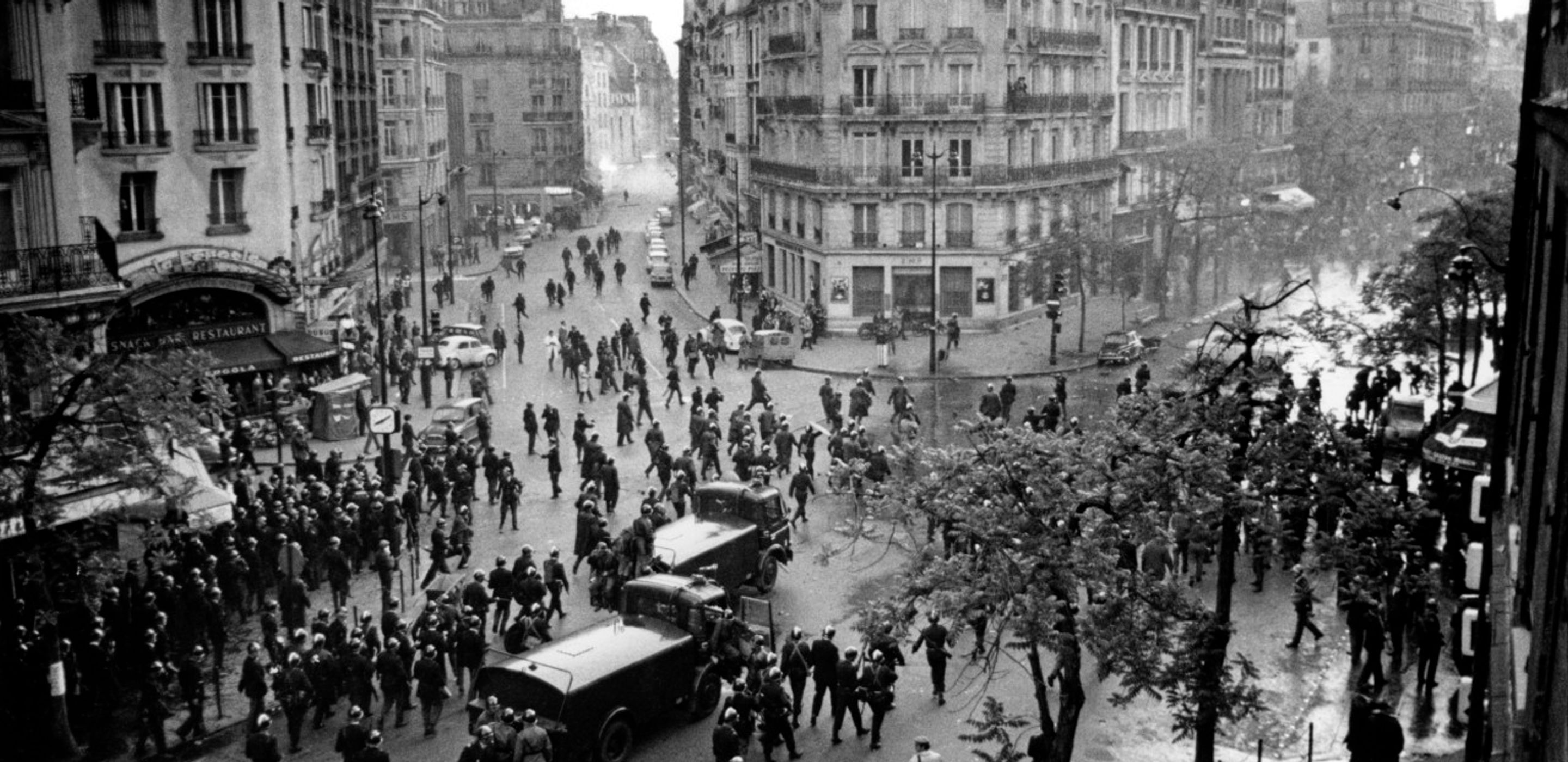
Nanterre was then a privileged university site for agitation. On March 22, a general assembly was held to demand the release of students arrested during a pro-Vietnamese demonstration. On May 2, the University of Nanterre was closed by order of the dean, and the police occupied the campus. On May 3, in the courtyard of the Sorbonne, a protest rally was held against the closure of Nanterre. Some of the students from Nanterre, no longer able to gather, decided to meet at the Sorbonne. In the afternoon, 1,500 police officers blocked the Sorbonne. They entered the building, and contrary to negotiations that had assured the students they could leave freely, they were arrested, clubbed and taken away in police buses. In the Latin Quarter, the buses were attacked by other gathered students. Some buses were opened, and the students were able to escape. There were clashes, 70 police officers were injured, and 600 people were arrested. It was a violent confrontation, and it must be remembered that the Paris police at that time were the same police who had fought in the Algerian War. The UNEF calls for a general and indefinite strike, with the slogans: “Free our comrades,” “Cops out of the Latin Quarter,” “The Sorbonne for the students.” From May 6 to 10, numerous demonstrations take place. On May 7, a demonstration gathered 45,000 people, including college students, high school students, teachers, as well as workers and the unemployed... On May 10, Nanterre reopened, and that evening saw the barricades, the “Night of the Barricades” from May 10 to 11 in the Latin Quarter. Thanks to transistor radios, “the Night of the Barricades went straight into history,” Alain Delale and Gilles Ragache would write ten years later.
On Saturday, May 11, a large crowd roamed the Latin Quarter. Prime Minister Pompidou broke his long silence to declare that the Sorbonne would reopen on May 13. Indeed, on May 13, the Sorbonne reopened and was immediately occupied, as was the Faculty of Medicine. There are demonstrations all over France, and students and workers often march together in the same processions. That day in Paris, a massive demonstration brings together 170,000 people according to the police, a million according to the organizers. Part of the demonstration is supervised by the CGT’s security detail.
On Tuesday, May 14, de Gaulle left for Bucharest, Romania, on an official visit, and Pompidou took charge of the government. The workers’ strikes begin. It seems that the first one started at a metallurgical factory in Lorraine, the Claas factory, where 500 metalworkers refused to return to work: a general strike was called. They demanded:
- implementation of a collective bargaining agreement in metallurgy;
- overhaul of the pay scale;
- improvement of working conditions;
- revision of time-keeping standards.
The most important point was undoubtedly the revision of timekeeping standards, that is, production rates. The Grenelle Agreements of May 27, 1968, concluded between the unions, employers, and the government, would focus primarily on joint agreements and wage restructuring, but very little on working conditions and even less on production rates.
By the end of the day on May 14, the Sud-Aviation factory in Nantes had been occupied and the director taken hostage in order to “obtain satisfaction of the demands that had been made previously”. The occupations extended to factories, universities, and cultural venues.
On the 15th, at the initiative of young workers, the Renault-Cléon factory was occupied. Four demands were put forward:
- a minimum wage of 1,000 francs;
- a gradual reduction of the workweek to 40 hours;
- expansion of trade union freedoms;
- conversion of temporary contracts for some staff members into permanent contracts.
From May 15 to 20, the strike spread across the country. Many factories were occupied, notably those of the Renault Group: Cléon, Flins, Sandouville, Le Mans, and Boulogne-Billancourt. The strike movement swept through the SNCF, EDF, and the PTT, as well as numerous enterprises in the secondary and tertiary sectors, leading to a “general paralysis” of the country. By around May 21, there were 9 million strikers: in other words, one in every two workers.
Alain Delale and Gilles Ragache write:
Agricultural workers, small farmers, college students, and high school students were far more numerous than in 1936 in supporting the workers’ battle.
In 1968, the French people experienced the largest strike in their history.
As the strike grew massive, it settled down. In the minority, it was fierce; in the majority, it sought to be “responsible.” Gradually, local slogans became standardized, and negotiations took place in Paris between employers and union officials, distancing workers from their own demands. The channeled strike became orderly. The labor federations took control of the situation: they had the leaders released, hung tricolor flags alongside the red ones, and took down the sacrificial mannequins.9
New riots erupted on May 24 in Lyon, Nantes, Paris, Strasbourg... That same day, de Gaulle addressed the nation:
Everyone understands, of course, the scope of the current events on university campuses and in society at large. We see all the signs demonstrating the need for a transformation of our society, and everything indicates that this transformation must involve broader participation by everyone in the running and results of the activities that directly concern them.
Certainly, in today’s tumultuous situation, the State’s first duty is to ensure, despite everything, the country’s basic functioning, as well as public order.
This is the most direct and democratic path possible: that of a referendum. Given the entirely exceptional situation in which we find ourselves, I have therefore, upon the government’s proposal, decided to submit to the nation’s vote a bill by which I ask it to grant the State, and first and foremost its leader, a mandate for renewal.
De Gaulle thus proposed to center the new policy on participation. To do so, he needed popular approval, which would take the form of a referendum. In the end, he had to give up on this idea.
The Grenelle Agreements, bringing together the unions, employers, and the government, were signed on May 27, 1968. That very same day, the CGT was disavowed by the workers at Renault-Billancourt over these agreements, even though the plant was a CGT stronghold. Tensions escalated between workers and unions, with clashes breaking out everywhere between strikers and management and “scabs”.10 Some factories and enterprises resumed work, but in many others, the strikers hardened their positions. “France is gradually splitting in two,” observe Alain Delale and Gilles Ragache. Law enforcement intervened with great violence in some factories.
In his speech on May 30, De Gaulle’s tone was quite different from the one he had used regarding “participation.” He dissolved the National Assembly and called for a stand against “totalitarian communism.” I quote:
Today, I am dissolving the National Assembly.
I proposed a referendum to the nation that would give citizens the opportunity to call for a fundamental reform of our economy and our university system, and at the same time to express whether or not they continued to have confidence in me through the only acceptable means: that of democracy.
I can see that the current situation makes it practically impossible to proceed with it, which is why I am postponing the date.
As for the general elections, it will take place within the timeframe set forth in the Constitution, unless the intention is to muzzle the entire French people by preventing them from expressing themselves at the same time as they are prevented from living, using the same methods employed to prevent students from studying, teachers from teaching, and workers from working.
These means are intimidation, intoxication and tyranny exercised by groups organized long in advance for this purpose and by a party that is a totalitarian enterprise, even if it already has rivals in this regard. [...] France, in fact, is threatened by dictatorship. They want to force it to resign itself to a power that would impose itself amid national despair, a power that would then obviously and essentially be that of the conqueror, that is, that of totalitarian communism.
It is significant to confront these two speeches. In both cases, de Gaulle put forward a proposal concerning the state, its institutions, and the electoral process: a referendum on May 24; on May 30, the dissolution of the National Assembly and the calling of new legislative elections. The referendum was directly linked to the presidential executive branch and its prerogatives. De Gaulle was asking the people for a mandate for renewal.
Faced with an outcry against the proposed referendum, and given the ongoing mobilizations and demonstrations, on May 30, de Gaulle called upon the party system and the Gaullist party to resolve the crisis, rather than relying on presidential prerogatives. The parties were mobilized to endorse police interventions, to put an end to the various occupations, to impose a return to work, and to launch the election campaign. The difference in tone between the two speeches is staggering. We move from participation to the specter of civil war and the threat of totalitarian communism.
The week of May 24-30 is decisive. A few highlights: on May 27, the Grenelle agreements (between unions, employers, and the government) were finalized, with the announcement of a 35% increase in the minimum wage. The government and unions had assumed that these agreements would put an end to the workers’ strikes, and thus to the factory occupations. But that was not the case. The agreements were overwhelmingly rejected by the striking assemblies, as I said, including in factories where the CGT had a strong presence, particularly in the automotive sector.
The second highlight was De Gaulle’s secret trip to Germany on May 29 to meet with General Massu, commander of the French Forces in Germany and a former general in the Algerian War who was heavily implicated in the torture and execution of both Algerian militants and their French sympathizers. Massu, assuring de Gaulle of the army’s support, convinced him to return to France and take decisive measures to re-establish “law and order.”
The decline in strikes essentially followed De Gaulle’s speech on May 30 and the Gaullist demonstrations that same day. In June, in areas where work had not resumed, factories were encircled by police. There were numerous instances of tension and clashes over the return to work between strikers and non-strikers, and between strikers and the police and gendarmerie, who intervened with increasing violence.
On June 10, Gilles Tautin, a seventeen-year-old high school student and member of the UJC(ml), drowned in the Seine while being pursued by the gendarmes. He had been participating in support of the striking workers at the Renault factory in Flins. The police had organized genuine manhunts throughout the region against all those, young people in particular, who had come to rally with the workers and protect the Renault factory against interventions by law enforcement and “scabs”.
On June 11, at the Peugeot factory in Sochaux, the Republican Security Companies (CRS) stormed the occupied factory, firing machine guns. Pierre Beylot, a striking worker, was killed instantly. Henri Blanchet fell from a wall after a grenade was fired and died. There were 150 wounded.
I want to emphasize the measures taken to restore order: negotiations with the unions, mobilization of the political parties in anticipation of the elections, mobilization of the Gaullist party, and increasingly harsh police repression.11 The legislative elections, in the second round on June 30, gave the Gaullist party a substantial majority.
There are two opposing forces from ‘68: on one side, the youth, the strikers, and the popular movements; on the other, the statists, Gaullists, Communists, and other parties, advocates of the state’s exclusive hold on power through its various apparatuses.
To speak of May ‘68 is not only to speak of the events, but also to speak of the intellectuality of politics. How can we do that today, more than fifty years later?
I took part in May ‘68. But I’m unable to describe what I was doing back then, even though I can share a few memories and anecdotes: funny situations, happy situations, serious ones, tragic moments, and violent and cruel situations. For me, May ‘68 isn’t a matter of memory; it’s a question of the intellectuality of politics.
I propose a distinction between the “taking-place” (l’ayant-lieu) and the “has-taken-place” (l’ayant-eu-lieu), two categories that do not coincide with the present and the past, even if they evoke them.12 By emphasizing the intellectuality of the present, the point is not simply to reflect on or articulate how we think the present, but rather how, in the present, in the taking-place, we think politics. And how, in light of this thought of politics that we have in the present, we analyze and formulate something about the has-taken-place, about this or that prior situation. I insist: it is from the taking-place that the intellectuality of the has-taken-place is articulated. In other words, it is by looking at the conceptions that we all have of politics today, how we think about it or attempt to do so, that what we say about politics in 1968 is articulated.
There is now a significant number of publications, particularly by the younger generation of historians. While they are certainly very scholarly on the subject of ‘68, in the name of sociology, culturalism, gender studies, and the sexual revolution, they largely overlook, in my view, the question of what actually happened there and what was at play politically.
It is from the intellectuality of the taking-place, of the present, that what is said about 1968 is articulated. Applying this to myself, I am summoned to what I have said about 1968 on three previous occasions when I took a stand. This illustrates how much these stances were deployed from what was, at each time, my problematic of politics and its categories of intellectuality.
Here are those three moments.
In 1969, along with Natacha Michel, Alain Badiou, and a few others, we decided to create a new Marxist-Leninist organization, the UCF(ml), explicitly backed by an interpretation of 1968 and the experience of the Chinese Cultural Revolution, particularly in its workers’ phase: the Shanghai Commune of 1966 represents a major reference point for the political capacity of the working class.
The slogan guiding the founding of the UCF(ml) was “Return the question of the party to the masses.” This was a proposition that was very characteristic of the rupture with vanguardism: certainly, the necessity of the party was maintained, but we were subverting Leninism by insisting that the question of the party had to be deliberately left open, so that it could be built together with workers and peasants. I think that “party” was still, at the time, the name for the very consistency of politics and its organization. It embodied what was still called “the overall perspective” and “proletarian ideology.” “Putting the question of the party back into the hands of the masses” also involves an element of pragmatism. For the question of politics is also played out in reality, depending on what people choose to do with it or not, on what workers put into practice or not, on what the youth articulate or not. It is the masses who decide: what do they decide?
In the creation of the UCF(ml), the inspiration remained classist: the proletariat, the workers, based on the hypothesis, still held at the time, that they possessed a political and subjective power capable of rallying the entire people. On the one hand, the maintenance of the hypothesis of the political capacity of the workers, and on the other, the search for a way to build a party of a new type in its relationship to the masses.
What may seem like an exorbitant claim in this call to authentic Marxist-Leninist parties of a new type was a means of touching on the core of politics as its own field. The fact of having insisted on a party of a new type, rather than on “struggles”13, required maintaining a certain level of political intellectuality by testing it against real experiences and the actual course of events. “Struggles” do not escape the major questions of political intellectuality, namely the inventiveness of the masses and their relationship to power. From the perspective of this intellectuality, two references are hopeless: struggles and the “great night,” and that of elections.
Fifteen years later, the UCF(ml) was succeeded by l’Organisation politique, and the reference to the party disappeared. The masses would become the people (les gens)14 through “politics from the point of people.” In 1981, after Mitterrand came to power, we dissolved the UCF(ml) and created l’Organisation politique in 1985, and with it, the closure of classism and Leninism, and set out to ground the political figure of the worker on something other than the support of class, class struggle, the dictatorship of the proletariat, and communism. This marked the beginning of a period in which the figure of the worker, in which the worker is no longer equated with class and the Marxist problematic, but rather with the factory, with the unusual yet highly operative slogan: “In the factory, there is the worker”, it is the worker who counts the worker, and who decides what he intends to do and not do with this word, politically, in the space of the factory. This has led, within the framework of l’Organisation politique, to the politics of factory worker cores, and to a series of highly significant mass situations.
My second piece on ‘68 appeared in Anthropology of the Name in 1996.15 In it, I wrote:
The anthropology of the name, which takes up thought, politics and the name, is, to my mind, the response, at last identifiable, to the intellectual caesura of May ‘68. For me, as for many people of my generation, 1968 represents a caesura in the sense that a great ‘eventality’ (événementialité) raises the question, sometimes over a long period of time and according to complex modalities, about what it brought to a close and what opened with it and after it. I have travelled over a great distance to answer this question.16
Anthropology of the Name poses the following central question: in politics, what can be done with the statements people think and thought is a relation of the real? In it, I develop a harsh critique of what I call “ideologism” and “movementism”, that is, a number of political forms that emerged in the years following 1968 and ultimately aligned with Mitterrandism.
In 2008, I co-authored a text with Claire Nioche on 1968, the real stake of which was not the 40th anniversary but the closure of l’Organisation politique.17 This closure did not call into question the validity of this essential distinction between politics from the point of people and politics from the point of the state, but it was based on the observation that there was no longer a mass base for our politics from the point of people, particularly among undocumented workers in the hostels. The end of the UCF(ml) decided the end of the party. What did the end of l’Organisation politique decide?
My political support in 2008 for addressing ‘68 lies in the split between politics from the point of people and politics from the point of the state, and in a replay of the figure of the worker in ‘68. This 2008 text supports the indisputable positivity of ‘68 and argues that what took place there is far removed from the category of revolution: it was part of a massive and inspired revolt against the conservative and police-state rigidity of Gaullism and the brutal, bureaucratic authoritarianism of the French Communist Party (PCF).
This short book explored the word “worker” at length, and I argued that “worker” only takes on meaning through politics, not through the economy or history. “Worker” only makes sense within a conception of politics, because it is politics that prescribes “worker” and not the other way around. For example, for the PCF and the CGT, the May movement, as it pertains to factory workers, is called the “great strike.” On the contrary, for militant far-left groups, May ‘68 marked a detachment of a fraction of workers from the PCF’s domination. The PCF and the CGT intended to continue negotiations for the joint government program between the PCF and the SFIO; to strengthen the CGT; and to combat “leftism” with the utmost vengeance and by any means necessary, particularly in the factories. This is what led the CGT and the PCF to claim that Pierre Overney, a former Renault worker and Maoist activist killed in February 1972 by a security guard at the gates of Renault-Billancourt, was an agent of the Ministry of the Interior. In contrast, the tens of thousands of people who attended his funeral at Père-Lachaise chanted “PCF, liar, accomplice of the killers.” It was, therefore, a time of relentless struggle by the CGT against revolutionary militants. Following Overney’s murder, and I’ll come back to this, it was the CGT that had reported the militants of the base committee to Renault management, whom management then rounded up from the assembly lines and handed over to the police at the factory gates. Clearly, for the CGT, “worker” was not a general category: it was not enough to be on the assembly line to be treated as such; the question of one’s relationship to the CGT was decisive in determining who it counted as a worker and who it excluded from that category. It must be said that the same was true for revolutionary groups. Belonging to the worker collective, in their sense as well, was a matter of political choice, of organized commitment. “Worker” alone has no political disposition of its own, and therefore does not exist as something already present for politics. “Worker” exists only when grounded in a prescription. The same holds true for the theme of workers’ unity: everything depends on the prescription. It is not without importance to recall this point. In practice, subordinating the use of the word “worker” to what is made of it politically is a harsh requirement.
Each of these three reinterpretations of 1968 is significant in terms of the political categories of the time. Am I able to meet the same requirement and stipulate the current political categories that now organize my relationship to ‘68? This is the exercise I am called upon to carry out.
The closure of Marxist classism has been central to my approach since 1969; it is already present in the UCF(ml)’s project to place the question of the party in the hands of the masses. But I do not know if I will ever be able to say that I am done with this closure. The question arises repeatedly: what has come to be closed within the closure?
With the UCF(ml), we brought an end to the self-proclaimed vision of the party, which I have also called the Leninist vision. This is not a shared given. To move beyond the party’s self-proclaimed vision is to move beyond ideas that proclaim themselves as constitutive of the space of politics; this requires thinking about politics from within itself and not from philosophy, history, or the economy; it requires placing the political thought of people and the processes it opens up at the center.
Next, with l’Organisation politique, we have closed antagonism as an organizing category of the workers’ consciousness. I recall the main principles of Marxist antagonism: the bourgeoisie is in an antagonistic relationship with workers; consequently, the workers’ consciousness must be antagonistic to the bourgeoisie. Revolution is the destruction of the bourgeois state, followed by the dictatorship of the proletariat, the abolition of private property, and the withering away of the state.
Investigations conducted in 1989, 1990, and 1991 allowed me to establish a key point: the abolition of private property did indeed take place at certain times in China, the USSR, and East Germany; in reality, there was no longer any private property, nor was there any currency in the sense of a general equivalent.18 In these investigations, we went to observe this firsthand, meticulously. This experiment took place and is conclusive: the abolition of private property does not abolish the state nor lead to its withering away.
The major question opened up by the end of classism is to break with antagonism, and to break with the idea that consciousness is a matter of a doctrinal subject that articulates workers’ consciousness with the refusal to subordinate to the state and capital.
I believe that in the current era, the question of values, principles, and the subjective must be addressed in and of itself; based on the subjective, starting from itself and its possibilities can formulate a relationship to institutions, the state, power, the police, war, etc.
What is at stake is starting with people’s own space of subjectivity—in terms of principles, values, points of reference, and practices. It is only once this has been articulated and unfolded that practical effects will emerge regarding how we act toward power and the state. We can gauge the importance and the stakes of the closure of Marxist classism.
What can be said about ‘68 in this endeavor of timelines of the present? What draws me in are the timelines of the subjective, of the different forms of people’s intelligence and the contents of their subjectivity.
The category of the arc of revolutions addresses, as we have seen, the difference between sequence and timeline. When I use the term “historical mode of politics,” dating delimits the sequence of popular political capacity. With the “arc of revolutions,” where “revolution” is understood as the destruction of the state (I will return to this later), it is also popular power that determines the dating. However, the arc of revolutions is not a sequence; it is neither homogeneous nor continuous, unlike the historical mode of politics. Its two temporal anchor points are the first and last historical occurrences in which a revolution takes place, understood once again as the destruction by popular power of an old state order and, upon its ruins, the construction of a new state order. It is an arc because it brings together heterogeneous subjective sequences. For this arc, I have chosen two dates: the beginning, 1792 in France, and the end, 1920, in Germany.
The arc of revolutions is not a historicization, a panopticon of historical modes of politics. It is a different entry point whose stake is to think today about the relationship between popular capacity and the state, once the closed nature of revolution has been established.
Politics, while it falls within the realm of the popular subjective capacity, does not fall within a historicist approach; but I would add that, paradoxically, neither does the state, once we approach it through the relationship that popular capacity has to it.
To return to ‘68. I have always considered ‘68 an obscure event, that is, one without a name. The only category available at the time was that of revolution, and it is not relevant. In all the literature that began to appear as early as July 1968, this theme is recurrent and yet profoundly inadequate.
Furthermore, I take a position against the current approaches that slice apart and stratify the events of May: there would have been the “student May,” the “worker May,” the “Parisian May,” the “Breton May”... All of this has been put through the social sciences’ rolling mill and their approach in terms of socio-professional categories and territories: there would have been the May of the bank employees in Marseille, the May of the Peugeot-Sochaux workers, the May of the nurseries in such-and-such a place, and so on. My criticism here is not directed at the highly documentary character of these works, but at their tacit or explicit pretension to treat politics in this way from the perspective of the people in 1968. To a large extent, they adopt the term “struggle”, omnipresent in 1968, as constituting the field of politics.
In the social sciences, what an individual does or says, and what a group of people does and says, is understood as expressive of, and causally referred to, their social origins and social territories. Socio-professional category, level of education, average income, age, gender, religious practice... are said to be the explanatory factors behind what people say, are, and do. I am opposed to this determinism, even though, of course, people’s social characteristics can have an influence, individually or collectively, we embody them, we express them, and so on; social and territorial determinants are very real, but I maintain that, when it comes to the politics of ‘68, we need to identify something else: I propose the category of national.
I call something national when it applies to everyone, that is, when it has meaning for everyone. This idea of a national without nationalism is a political “inspiration” that is not state-based. This thesis may seem to contradict the slogans of “workers’ power,” “students’ power,” “peasants’ power” — power fragmented, in a sense, into multiple social categories — but in my view these slogans demonstrate that 1968 proposed no alternative form of state. “Workers’ power,” “students’ power,” and “peasants’ power” can be understood as so many calls to action, to a new inspiration and subjectivity, within the spaces where people live and work. This is not a central, overarching alternative. “Power” is thus unrelated to state power; it is a popular capacity with power.
In 1968, a possibility emerged for everyone. A possibility that was neither planned nor orchestrated: what inspires is the power of people, the power of the masses; it is this that spreads from one person to another, a phenomenon of inspiration and emotion.
Take the night of the barricades from May 10 to 11. Within a few hours, the Latin Quarter was spiked with barricades, more than eighty of them, made of cobblestones, cars, construction materials... Violent clashes with the police lasted for hours, until the brutal charges in the early morning that “liberated” the quarter — according to the official version. All of this unfolded live, via regional radio stations, RTL, Europe, with all of France hooked on their transistor radios, following in real time what was happening at the barricades.19 The next day, May 12, there was a meeting of most of the major unions, which decided on a general strike for May 13, a so-called strike of solidarity with the students and against repression. The day after this general strike, on the 14th, strikes involving factory occupations began. I would suggest that, on the side of the barricades and among the people there, things were said and done that were valid for everyone, that meant something to everyone: it touched everyone. Everyone was affected, positively or negatively; in fact, “national” does not mean “unanimous,” but that everyone is called upon.
Admittedly, this is a retrospective thesis, but all of us who, in the days that followed, went to meet the workers in the factories, warehouses, and small workshops, were told: “You students, what you did with the barricades was amazing.” The link that was forged between students and workers is largely the result of the students’ participation in the barricades.
Starting on May 14, with the beginning of the factory occupations, the conjuncture changed: a new situation where the question arose of the relationship between the mobilization of the youth (universities, high schools) and that of the workers and employees. On and around the barricades, there were students but also many other people, and this would continue in most of the mobilizations of May ‘68. In particular, resisting and fighting against the police was a unifying factor among different people. Moreover, in June, when the factories were attacked by the police, large-scale student movements to protect the occupied factories took place. Students led by the UJC(ml) joined the workers at Renault-Flins to resist the police. It was there that high school student Gilles Tautin was killed.
The “worker figure” is always situated within a specific context: here, it is the factory occupations. And it is precisely this subjectivity, this singular practice of workers’ relationships with one another and with their bosses, that creates the event. The occupied factories and the organizing that takes place around them fall under the banner of “for all,” of the national in this sense. Again, in a similarly contradictory way.
I would like to emphasize the subjectivity of people, their inventiveness, their enthusiasm in ‘68. Everyone wants to know what others are saying, thinking, proposing. There is an absolutely extraordinary positivity toward otherness. This inventiveness is shared: it is displayed in the streets, circulating; there are thousands of leaflets, posters, graffiti... The difference is striking between the open spaces that were the streets, universities, and certain factories, and the closed spaces under the control of the PCF and the CGT.
The categories of revolution and proletarian classism have no real place there, even if they appear lexically. I believe that ‘68 falls into the category of inspiration and liberation, and not at all into that of revolution. Liberation of speech, of invention, of listening to others, of the use of the street, of public spaces. The thesis “people think” is part of this lineage.
Translated by Cam West
Notes
-
Translator’s note: I have retained Gila Walker’s translation of ‘événementialité’ from the 2015 English edition of Anthropology of the Name.
↩ -
The line of the proletarian syndicalists of the UJC(ml), “Serving the People.”
↩ -
In April 1960, People’s Daily, the official newspaper of the Central Committee of the Chinese Communist Party, published a series of articles criticizing the policies of the USSR under the headline: “Long Live Leninism.”
↩ -
See Maurice Thorez’s interview with The Times on November 18, 1946.
↩ -
Translator’s note: Patrick King translated an article by Frédéric Chateigner, “From Althusser to Mao: Les Cahiers Marxistes Léninistes”, for Décalages, which provides an account of the journal’s development over the course of the sixties.
↩ -
Translator’s note: Jason Smith, in an article on French Maoism for Viewpoint Magazine, discusses the difficulties of translating this term. “There is no ‘established’ translation for this particular term in English language accounts of this movement. In the article translated in this issue of Viewpoint, we have chosen, with some regret, to leave the term untranslated. In all likelihood, the term was derived from a speech made by Mao Zedong in early 1957, and subsequently translated into French… We find the two forms of militant practice that would form the backbone of French Maoism and shape the trajectory of its first grouping: the investigation or enquête, and settling down, or s’établir (as the French translations of Mao’s Mandarin had it). The title of the programmatic UJCml tract establishing the aims, scope, and tactics of the établissement movement could very well be translated: ‘On Settling Down.’ And the individual militants that practice this tactic: settlers.”
↩ -
Jean Bigiaoui, a longtime friend, since he was part of the Daguerre Vietnam Base Committee (Paris XIV) while I was part of the Plaisance Vietnam Base Committee (Paris XIV), kindly agreed to proofread the entire Timeline with his characteristic meticulous attention to detail. I would like to thank him.
↩ -
I will draw heavily on the excellent book by Alain Delale and Gilles Ragache, La France de 68, (Paris: Seuil, 1978).
↩ -
Ibid, 88–89. At the entrance to some factories, there were straw or paper mannequins representing the boss or foreman.
↩ -
Translator’s note: Lazarus uses “jaunes” here, which would directly translate to “yellows”. I chose “scabs” since the informality of the term reflects how English speakers refer to strike-breaking workers.
↩ -
A presidential decree dated June 12, 1968, banned about ten organizations and groups: Revolutionary Communist Youth (JCR), Workers’ Voice (VO), the “Révoltes” Groups, the Union of Marxist-Leninist Communist Youth (UJC[ml]), the Internationalist Communist Party (PCI), the Marxist-Leninist Communist Party of France (PCMLF), the Internationalist Communist Organization (OCI), and the March 22 Movement.
↩ -
Translator’s note: I have retained the translation of these two terms, the taking-place and the has-taken-place, from Gila Walker.
↩ -
In 1968, struggle was portrayed as the defining feature of politics. Here are a few examples of posters: “The struggle continues at the Provence metallurgical construction site,” “For the struggle of all workers, the steelworkers will stand firm,” “Long live the workers’ struggle in all companies,” “Maine-Montparnasse, the struggle continues,” “Following Renault’s example, let’s keep fighting,” “Long live the exemplary struggle of the Flins workers,” “Keep up the fight, RATP Action Committee,” “The struggle will prevail.”
↩ -
Translator’s note: It’s important to emphasize that Lazarus is using “les gens”, which renders people indistinct. Or in other words, he’s not invoking the people as in populist or democratic discourses, but people in an informal sense — like folks or guys in English. He elaborates on this in “Can Politics be Thought in Interiority?”.
↩ -
In 1978, in a pamphlet titled “An Assessment of May ‘68,” I wrote: “If we’re talking about ‘68 at the moment, it’s partly because of the tenth anniversary, but mainly because the Union of the Left was, as seen by the PCF and the PS, the outcome of ‘68, at least the one they wanted to draw from it and could draw from it. Now that there is no longer a united left, now that the PS and the PCF are conducting politics in their own names, as parties and no longer behind a ‘program,’ May ‘68 is resurfacing, as if the Common Program had attempted to be an answer to it or to mask it, and as if the failure of the Common Program, the failure of that answer, therefore, brought us back to the initial questions, to what was its subject matter, that is, ‘68. This is where a new, nascent history begins: with and after ‘68, times are new. What is novel? Where can it be seen? Where can it be read? In its quest, in its own search, tireless for ten years, and marked by two resounding failures: that of the Gauche prolétarienne in 1973 and that of the union of the left in 1978.”
↩ -
Lazarus, Anthropology of the Name, trans. Gila Walker, (London: Seagull Books, 2015), 9.
↩ -
Sylvain Lazarus and Claire Nioche, May ‘68: Politics and History (Paris: Le Perroquet, 2008). Translator’s Note: This is a different text than the one translated here. They just happen to share the same name.
↩ -
See Christian von Hirschhausen, From Socialist Combine to Capitalist Enterprise.
↩ -
So much so that a little later, the Minister of the Interior ordered the shutdown of these two radio stations’ relay stations. So, in order to continue transmitting what was happening on the streets, the journalists didn’t hesitate to knock on people’s doors and ask them to use their phones.
↩