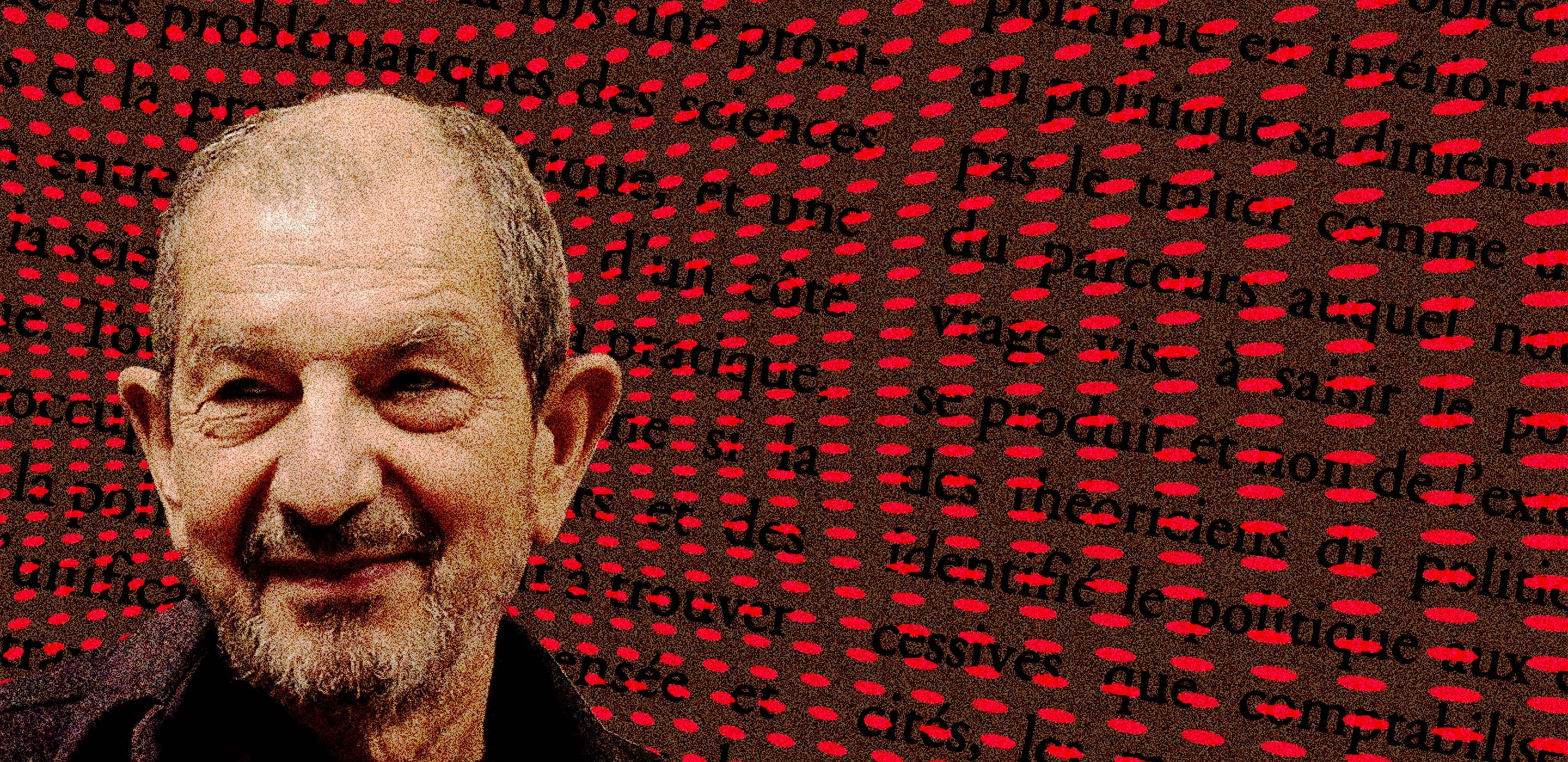
Introducing the "Late" Lazarus
Chronologies du présent was published in 2022, and the book features a series of lectures given by Sylvain Lazarus in 2018. Lazarus’s only two other books are Anthropology of the Name, published in 1996 and translated into English in 2015, and L’intelligence de la politique, published in 2013 featuring a series of essays by Lazarus from 1978-2003. Fracture has published translations of two chapters from Chronologies du présent in this issue: chapter three: “Timelines: the Two Arcs”, and chapter four: “May ‘68: History and Politics”. We present a brief introduction of the two essays and the “Late Lazarus” here.
Little is known about Lazarus in the Anglophone world, and for a while, he was known merely as a friend and intellectual collaborator of Alain Badiou. This interpretation can be seen in various places, notably Peter Hallward’s book on Badiou and in Bruno Bosteels’ essay on Badiou’s post-Maoism.1 Lazarus receives little mention in Hallward’s book, and only appears four times in the text. He appears slightly more in Bosteels’ shorter essay, but even then his role, whether intellectually or politically, always appears subordinate to Badiou. As Bryan Doniger says, “most of the interpretations of Lazarus published in English are heavily reliant upon Alain Badiou’s understanding of his project… They read Lazarus primarily as a critical interlocutor who helps clarify and bolster Badiou’s views on politics.”2 Doniger argues that Badiou himself is responsible for perpetuating this reading, and cites Badiou’s essay in Metapolitics on Lazarus where he attempts an explanation of Anthropology of the Name.3
While Badiou’s work has blossomed in the twenty-first century and almost all of his major texts have been translated into English, Lazarus has received very little attention. The only works of Lazarus that have been translated into English and published are “Lenin and the Party” (2007), Anthropology of the Name (2015), “Can Politics be Thought in Interiority” (2016), “Workers’ Anthropology and Factory Inquiry” (2019), and most recently, “Subjective Singularities” (2022).4 The latter is the fifth chapter of Chronologies du présent, and the translation published by Crisis and Critique also included the introduction by Claire Nioche, the first chapter on “The Two Classisms”, and the conclusion on “The Subjective Without Organization”. We can see, just by looking at the dates of the translations, that Lazarus’s work has only gained traction amongst Anglophone readers in the last decade, two decades after Badiou. Michael Neocosmos and Asad Haider have played a major role in popularizing Lazarus.5
We at Fracture believe that Lazarus is a monumental figure. This is not just because of his relation to Badiou, but in his status as a part of a constellation of thinkers who sought to confront the crisis of Marxism in both his theoretical and political work. A larger essay will be written in the next issue on Lazarus’s larger political and intellectual trajectory, but for now I will offer a brief outline:
1. The “early” Lazarus: he began his political journey in 1966, two years before May ‘68, in the Vietnam Base Committees (CVB).6 These were the militant, Maoist inspired organizations that sought to center the Vietnam War and French imperialism in everyday life through various forms of struggle and agitation.7 After May ‘68, Lazarus initially joined the Gauche proletarienne (GP), the most popular French Maoist group, but grew quickly disillusioned with their political practice. He would, however, only leave the GP for something else, so he and his partner Natacha Michel decided to create a new organization. They went on a trip to Italy to investigate Maoist groups and then began forming the Union of French Communists, Marxist-Leninist (UCFml). Michel’s childhood connection, Cecile Winter, the long-term partner of Badiou who passed away in 2021, told Badiou of this new formation which he then joined.8 Lazarus describes the UCF(ml) as a classist, post-Leninist organization which was already experimenting with some of the theses that Lazarus would eventually develop, including thinking politics from within itself. Their interventions are largely in factory struggles during this period, but they engage in a wide range of activity.9 Notable works from Lazarus in this period include “What is a Marxist Politics?”, published in 1978, and “Working Notes on Post-Leninism”, published in 1981. The early Lazarus is a Maoist, or post-Leninist, militant.
2. Lazarus’s “mature” period begins with the closure of the UCF(ml) and the foundation of l’Organisation politique (OP) with Michel and Badiou. Lazarus’s “Can Politics be Thought in Interiority”, published in 1985 initially as a conference presentation, can be read almost as a founding text for the OP. The text is the first proper statement of his mature way of thinking — he introduces his founding statement, “people think” and provides a presentation of historical modes of politics and politics in interiority. Harper’s translation cuts off the first two pages, and I’ve included a translation of them here to make Lazarus’s intentions clear:
I would like to propose to you today a new project for politics.
Today, in 1985, as we are in the process of founding a new organization: l’Organisation politique, we can not just call ourselves “post-Leninists”. A new conception of politics can be advanced.
Let us list the referents that have been abandoned. We reject the party, a form of organization that leads to the party-state. We dismiss thought in terms of classes. Returning one last time to the prefix “post-,” we note that the situation is “post-classist.” Classes and class contradictions, if they exist, are in any case inoperative in the subjectivity of what we call “people,” as our investigation shows. We take note of the crisis of the notion of antagonism. Finally, we abandon the term “masses”, that essential piece of Maoist lexicon, in favor of the term “people,” a more open category. With this new term, we presuppose nothing. “People” is a certain indistinct: we prejudge nothing (which renders it “indistinct”), except for their existence (“certain”). Likewise, while we abandon the party form, we stand firm on that of organization: there is no politics that is not organized.10
This is the Lazarus most have come to know. The author of Anthropology of the Name and the theorist of people think and the lapsing of classism. All of the previous translations of Lazarus take place in this period, outside of “Subjective Singularities”.
3. The closure of the OP in 2007 marks the beginning of the “late” Lazarus. The closure of the OP is marked by the split between Badiou on the one side, and Lazarus and Michel on the other. The split centers around the notion of communism itself, although the difference in Badiou and Lazarus’s theoretical approaches also play a role. Badiou’s universalism and Lazarus’s singularity could no longer be reconciled.11 Badiou drifts back to Marxism while Lazarus declares communism itself to be saturated. Winter refers to Lazarus scornfully in a footnote to her essay in The Idea of Communism 3, “Liberating Dictatorship: Communist Politics and the Cultural Revolution”, saying Lazarus’s renunciation of communism is disturbing and even renounces him as a militant.12 To be clear, Fracture isn’t willing to go quite as far as Lazarus on the saturation of communism. We think of communism as an instance of emancipatory politics in general, as we outline in, “A Fractured Lineage”.
Returning to the question of Lazarus’s later works, the chapters of Chronologies du présent published in Crisis and Critique hint at some new developments: such as his exploration of politics today in relation to the Gilets Jaunes, or Yellow Vests, in France in 2018, and specifically the notion of politics without organization, which he identifies in the movement. His main project in this book is to explore what a politics from the point of people might look like today after the lapsing of classism and the apparent impossibility of a sustained mass politics. The two chapters translated in this issue of Fracture see Lazarus providing his own assessment of his intellectual trajectory and some conceptual explorations on the state and revolution.
The first essay, “Timelines: the Two Arcs”, sees him develop his theory of politics as sequential. He introduces the concept of “timelines” in an attempt to stitch together the various sequences he has previously identified: the revolutionary, classist, Bolshevik, and dialectical modes for politics in interiority, and the Parliamentarian and Stalinist modes for politics in exteriority.13 The four modes in interiority stand in for the French Revolution (revolutionary), Paris Commune (classist), Russian Revolution (Bolshevik), and the Maoism practiced by the Chinese Communist Party during the War of Liberation (dialectical). The revolutionary, classist and Bolshevik modes take place in “the arc of revolutions” which begins with the French Revolution in 1792 and closes after the subsumption of the soviets into the Communist party-state and the ending of the German Revolution in 1920. For Lazarus, revolution is specifically understood as a political process that transitions from a State 1 to a State 2. It’s the replacement of one form of state with another. In Anthropology of the Name, he writes:
The historicist perspective calls “revolution” the turbulent and violent transition between one state of society (called State 1) and another, qualitatively different state (called State 2). The role attributed to the different events of the revolution are weighed in relation to the two essential terms that are the end of State 1 and the establishment of State 2. According to this conception, an event cannot in itself have revolutionary significance unless it enters in some way into the process of mutation from State 1 to State 2. Although for many years before the French Revolution, there were riots, looting and attacks on grain convoys, which were perhaps premonitory, no one considers them pre-revolutionary. But analogous events after 1789 and the meeting of the Estates-General are regarded as revolutionary. Therefore it is not the event—the formal characteristics of the event—that is decisive. It is its presence or absence within the limits that mark the boundaries of the phase, deemed a phase of mutation.14
This type of political process no longer unfolds after 1920, where he identifies the beginning of the “arc of party-states”.
One might wonder how Lazarus would classify the Chinese Revolution of 1949 which led to the creation of the People’s Republic of China (PRC). Lazarus, however, contests the designation of the creation of the PRC as a “revolution”, and instead refers to it as a revolutionary war. He says:
In the common usage of the word “revolution,” any mass uprising is a revolution. My thesis is that there are major historical positives that do not fall under the signifier “revolution.” Unless we say that revolt and the creative power of people are signed, everywhere and always, by the word “revolution.” I do not think so. National liberation struggles and guerrilla movements also do not fall under the category of revolution in the sense that I understand it, which in no way diminishes their historical importance.
This essay also sees Lazarus sketching out a theory of the state, which Louis Althusser infamously noted as one of the blind spots in Marxist theory. Lazarus and Badiou both notably advocate for a politics at a distance from the state throughout their work, and Lazarus is especially skeptical of the state. He argues there can be no alternative form of state that’s distinct from how it existed under parliamentarianism or Stalinism — the two modes of politics in exteriority he identified all the way back in 1985.15 To think of politics on the terrain of the state is, for Lazarus, to negate the subjective capacity of people. It places thought in the hands of the state and politicians who will act on behalf of people.
Lastly, Lazarus invokes the category of the aleatory, although without citing Althusser, to argue that revolutions are aleatory opportunities for a different form of government. This is continuous with his analysis of Lenin in “Lenin and the Party”, where he advances the notion that history is clear and politics is obscure in Lenin’s thought. He cites a passage from Lenin who, after returning to Russia from exile in Switzerland, notes that “one can know” what will happen after the February Revolution. Politics begins from this position of obscurity.
The other essay, “May ‘68: Politics and History” is unique in his work in that he provides both a summary of events in May ‘68 while also situating his own political and intellectual trajectory in relation to them. Lazarus separates the actors of May ‘68 into two camps: “on one side, the youth, the strikers, and the popular movements; on the other, the statists, Gaullists, Communists, and other parties, advocates of the state’s exclusive hold on power through its various apparatuses.” He introduces two categories in order to think May ‘68: the “taking-place” (l’ayant-lieu) and the “has-taken-place” (l’ayant-eu-lieu). He does so in order to avoid the pitfalls of retrospective thinking on events, and to emphasize that any perspective on something that has taken place does so from what’s currently taking place. He demonstrates this through his various interpretations of May in relation to his own political practice.
Lazarus discusses how the UCF(ml), founded in 1969 with Badiou and Michel, was born out of a specific interpretation of May ‘68. Mainly, they wanted to return the question of the party to the masses. This type of politics was still Marxist and classist. Eventually, the UCF(ml) was succeeded by l’Organisation politique in 1985. He says:
The reference to the party disappeared. The masses would become the people (les gens) through “politics from the point of people.” In 1981, after Mitterrand came to power, we dissolved the UCF(ml) and created l’Organisation politique in 1985, and with it, the closure of classism and Leninism, and set out to ground the political figure of the worker on something other than the support of class, class struggle, the dictatorship of the proletariat, and communism.
The l’Organisation politique ended in 2007, and Badiou and Lazarus/Michel split. The organization’s closure was, “based on the observation that there was no longer a mass base for our politics from the point of people, particularly among undocumented workers in the hostels.” He returns to May ‘68, discussing how workers don’t necessarily have any political value — it’s dependent on politics, which is dependent on prescription. Lazarus draws strong conclusions and argues the following concepts are closed or saturated: party, workers, antagonism, etc. He says:
Investigations conducted in 1989, 1990, and 1991 allowed me to establish a key point: the abolition of private property did indeed take place at certain times in China, the USSR, and East Germany; in reality, there was no longer any private property, nor was there any currency in the sense of a general equivalent. In these investigations, we went to observe this firsthand, meticulously. This experiment took place and is conclusive: the abolition of private property does not abolish the state nor lead to its withering away.
Returning to May ‘68, Lazarus refuses to think of it as a revolution — not only for the reasons he generally opposes thinking of other sequences as revolutions, but because May ‘68 never put the seizure of power on the agenda. He says:
The categories of revolution and proletarian classism have no real place there, even if they appear lexically. I believe that ‘68 falls into the category of inspiration and liberation, and not at all into that of revolution. Liberation of speech, of invention, of listening to others, of the use of the street, of public spaces. The thesis “people think” is part of this lineage.
Lazarus’s analysis strikes a lot of similar notes to Kristin Ross, most notably articulated in her book May ‘68 and Its Afterlives. Both Ross and Lazarus emphasize the importance of the street as the site of politics, rather than the factory occupations of the CGT that were largely designed to keep workers in their place.
Both essays published in this issue from Chronologies du présent touch on the themes of the state and the concept of revolution. The question of the state is especially relevant today for those interested in emancipatory politics. Throughout the world, left-wing politics has increasingly centered on the state — sometimes successfully, other times not. There have been recent successes in the United States with DSA endorsed candidates winning elections, most notably Zohran Mamdani becoming the Mayor of New York City in 2026. Other left-wing politicians, like Bernie Sanders and Jeremy Corbyn in the UK, were unable to reach the summit of political power in their respective governments. While the editors of Fracture largely adhere to the position on the state advanced by Badiou and Lazarus, a position of skepticism that emphasizes political activity outside and away from the state, we acknowledge that the relation between politics and the state must be confronted head on today. In this vein, we invite readers to explore these two provocative and stimulating essays by Lazarus on the state, revolutions, and political movements.
Notes
-
See: Peter Hallward, Badiou, (Minneapolis: Minnesota University Press, 2003), and Bruno Bosteels, “Post-Maoism: Badiou and Politics”, positions (Volume 13, Issue 3), Winter 2005.
↩ -
Bryan Doniger, “The Enthusiasm of Political Sequences: Notes on Sylvain Lazarus’s Anthropology of the Name”, Krisis (Issue 2), 2021, pages 19-20.
↩ -
Alain Badiou, Metapolitics, (London: Verso, 2005).
↩ -
See: “Lenin and the Party”, in Lenin Reloaded, (Durham: Duke University Press, 2007); “Can Politics be Thought in Interiority”, translated by Tyler Austin Harper, Cosmos and History (Volume 12, Issue 1), May 23, 2016; “Workers’ Anthropology and Factory Inquiry”, translated by Asad Haider and Patrick King, Viewpoint Magazine, January 9, 2019; and “Subjective Singularities”, translated by Robert St. Clair, Crisis and Critique (Volume 9, Issue 2), November 25, 2022.
↩ -
“For Asad”, published in this issue, discusses Haider’s engagement with Lazarus. For Neocosmos, see: Thinking Freedom in Africa and “Civil society, citizenship and the politics of the (im)possible: rethinking militancy in Africa today”.
↩ -
Lazarus discusses this on the back cover of L’intelligence de la politique, (Aix-en-Provence: Al Dante, 2013).
↩ -
Kristin Ross discusses them in May ‘68 and Its Afterlives, (Chicago, University of Chicago Press, 2002), 90-99.
↩ -
Michel outlines the history of her, Lazarus, and Badiou’s political journey in Roman de la politique, (Paris: La fabrique éditions, 2020), 9-40.
↩ -
Bosteels explores this in “Post-Maoism: Badiou and Politics”. Marcelo Hoffman analyzes the UCFml’s activity in the countryside in their attempts to organize peasants. He focuses specifically on their Le livre des paysans pauvres (The Book of Poor Peasants), written in 1976 as a balance sheet of their activity. See: Hoffman, “Alain Badiou, the Maoist Investigation, and the Party-Form”, Historical Materialism (2017), 1-18.
↩ -
Lazarus, L’intelligence de la politique, 101.
↩ -
Michel provides an account of the split in Roman de la politique, and she also reproduces a letter she received from Badiou on the matter.
↩ -
Winter: “It is saddening – and at the same time disturbing – to see our formerly close comrade Sylvain Lazarus writing on the back cover of a collection of his political writings, with a preface by Natacha Michel, ‘The withering away of the State did not take place!!’, in order to justify his renunciation of the communist idea. Are we to understand that the state should have withered away during the lifetime of Sylvain Lazarus? We are mischievously tempted to write: of course, dear Sylvain, we have whatever little Kautskys we can get; dear Natacha, don’t you think the ancient queen Semiramis must be convulsed with laughter in her tomb? And how can you then claim the word ‘militant’ for yourself? We now find ourselves compelled to deny it to you. What is a militant, if not first of all someone who agrees to work – for free – in the service of something that from every perspective transcends her?”, 259.
↩ -
These are all elaborated in “Can Politics be Thought in Interiority”. Lazarus has a very specific concept of historical modes of politics which are understood as sequences with a beginning and end. Modes of politics are identified by their places. For the Bolshevik mode, the places are the Party and Soviets. Once the places disappear or close, so does the mode. Thus, once the Bolshevik party became the party-state while also subsuming the soviets, the Bolshevik mode ended. The Stalinist mode follows, and it is a mode in exteriority since it refers to an external object: the state. It is no longer a mode of emancipatory politics.
↩ -
Lazarus, Anthropology of the Name, translated by Gila Walker, (Kolkata: Seagull Books, 2015), 177. Lazarus adds: “Whenever revolution takes on a structural sense, which is the case in history, the category becomes inoperative as far as the process of analysis of politics is concerned. Positing that the category of revolution has been saturated and exhausted by the event of the French Revolution — which means, of course, identifying the latter — proceeds from a conception of politics that considers it sequential and singular. On the contrary, the structural use of the notion of revolution ineluctably produces a typological approach, which does not allow for an investigation of the singularity of politics; it will never be recognized, in what has taken place, that a process of politics has been completed. I uphold the thesis of sequentiality and, hence, that of the completion of a politics, against a view of history as always bouncing back from itself, which is at work in the structural approach” (179).
↩ -
Lazarus, “Can Politics be Thought in Interiority”.
↩