Egalitarian Exceptions
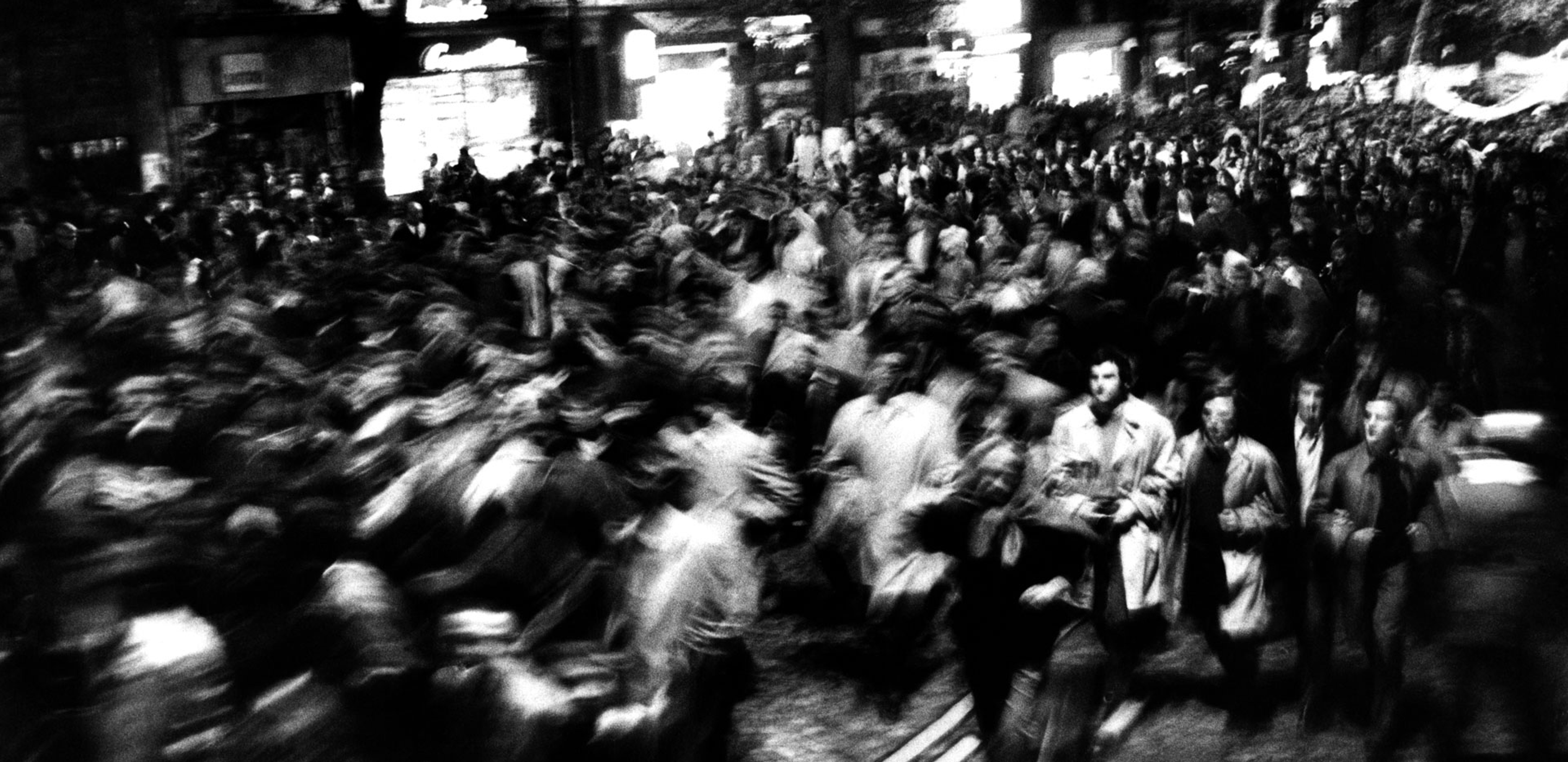
William Klein’s 1978 documentary on May ‘68 in France, Grands soirs et petits matins, begins with countless conversations in the street where individuals discuss the largest general strike and mass movement in the country’s history, and what to do: about de Gaulle, about the state, about creating a revolution, about the party, etc. These people are indistinct and unknown. Characters drift in and out of the picture. You have no idea who they are, beyond the fact that they are out in the street with tens of thousands of others engaged in heated discussion. Sylvain Lazarus, in his analysis of May ‘68, emphasizes this enthusiasm towards politics. He says, “I would like to emphasise the subjectivity of people, their inventiveness, their enthusiasm in ‘68. Everyone wants to know what others are saying, thinking, proposing. There is an absolutely extraordinary positivity toward otherness. This inventiveness is shared: it is displayed in the streets, circulating; there are thousands of leaflets, posters, graffiti…”.1 Lazarus goes on to connect this enthusiasm of people to his thesis that “people think”, which is his foundational statement for politics.2
The events of May ‘68 were driven by a remarkable scale of pluralization3 with the creation of new organizations outside of the existing political parties, most notably the French Communist Party (PCF). The bulk of these organizations were called action committees and their practices were expansive: they organized tenants, supported strikes, joined in demonstrations, etc.4 Their organizational antecedents were the Vietnam Base Committees (CVBs) which formed around 1966 and provoked the university conflicts that led to May ‘68 in the first place. The action committees began to form after the night of the barricade on May 10th. There were three types of committees: local committees based on district, university committees divided by branch, and work committees in factories and offices. The committees were not connected with any specific political tendency and were open to all militants. They were designed as instruments of struggle, they comprised small groups of people (10-30), and they were supposed to be explicitly political.5 Kristin Ross, in May ‘68 and its Afterlives, says the action committees embodied a Luxemburgian orientation towards situational politics and calls them the most significant form invented in May.
Small groups of perhaps ten or fifteen people, most of whom had belonged to no preformed political group, began to organize—by profession in some cases, by neighborhood or factory in others—after the general strike began in mid-May, largely with the goal of providing material aid to the strikers and producing agitprop to extend the strike. By May 31, over 460 such committees existed in the Paris region alone; “action committees” had appeared in the high schools (CALs) as early as February.6
Some committees persisted for months and even years after May itself.7
May ‘68, for Lazarus and Ross, was defined by its inventiveness, both at the level of organization and the level of culture via posters, print materials, and public discussions. The inventiveness of people during these situations is symptomatic of a rupture with the ordering regime.8 In every ordering regime, people are arranged neatly into categories: whether that of worker, student, man, woman, etc. The rupture produces a schism with the ordering regime and it becomes possible for individuals to vacate the place that’s been assigned to them. Ross says:
May ‘68 had very little to do with the social group — students or “youth” — who were its instigators. It had much more to do with the flight from social determinations, with displacements that took people outside of their location in society, with a disjunction, that is, between political subjectivity and the social group. What is forgotten when May ’68 is forgotten seemed to have less to do with the lost habits of this or that social group, than it did with a shattering of social identity that allowed politics to take place.9
This disjunction between political subjectivity and social group, the flight from social determinations, and the shattering of social identity is at the heart of emancipatory politics.
These features are not solely reducible to May ‘68, as the inventiveness of people and the enthusiasm of politics has featured in other moments of crisis and rupture, moments we often tried to understand as so many aborted revolutions. Marcel Liebman, describing the mass culture of the Russian Revolution in 1917, paints a picture of constant debates and dialogues between people in the streets, in courtyards, and on public transportation. He says, “This liberation of speech burst forth all over the place, producing a state of continuous discussion.”10 Nadezhda Krupskaya, Lenin’s wife and a fierce revolutionary in her own right, paints a picture of such a scene:
The house in which we lived overlooked a courtyard, and even here, if you opened the window at night, you could hear a heated dispute. A soldier would be sitting there, and he always had an audience-usually some of the cooks or housemaids from next door, or some young people. An hour after midnight you could catch snatches of talk– ‘Bolsheviks, Mensheviks …’ At three in the morning: ‘Milyukov, Bolsheviks …’ At five-still the same street-corner-meeting talk, politics, etc. Petrograd’s white nights are always associated in my mind now with those all-night political disputes.11
We often call this kind of situation of crisis or rupture a revolution, and it is commonly thought of in relation to politics at the highest level: the destruction of old regimes and the formation of new states, jockeying between political leaders and politicians, the bloody repression of factions and militants, and so on. Yet the rupture, both what produces it and sustains it, is driven at the molecular level — the level of mass activity and invention. Even in Krupskaya’s anecdote, you see a spirit of vitality at this level in spirited conversations between soldiers, cooks, housemaids, and young people about what can be done about the situation. These types of scenes are infinite, and they occur in every revolutionary situation.
The theme of searching for a new mode of politics is prevalent in the theoretical framework explored by Fracture. While searching for a new mode of politics can be understood in the Lazarusian sense, in that contemporary militants are waiting for a new sequence to arrive, it must also be understood in the sense of producing a new political framework that is adequate for politics today. While my conceptual labor in this essay is relatively brief and requires further development, I believe the categories I will introduce can enable both a better grasp of the history of communism in the twentieth century, as well as a framework that can formulate the tasks of emancipatory politics today.
The Problem of Organization and the Crisis of Marxism
Both the Russian Revolution and May ‘68 were significant episodes in the history of emancipatory politics, and they are worthy of careful study for anyone committed to such a politics today. However, sustaining an emancipatory politics today is not as simple as applying the forms of thought that drove old modes of politics. Due to the exhaustion of communist politics in the twentieth century, the question of politics and its organization today is fundamentally open.12
Before proceeding further, it’s important to make a distinction between emancipatory politics and communism. Communism as a politics asserts that this world is not necessary, and that both the capitalist mode of production and the state must be dismantled in order for emancipation to be possible. However, there have been many attempts at emancipation that have existed before communist politics. Communism is an instance of emancipatory politics, but it’s not entirely reducible to it.
Emancipatory politics begins with a decision on people’s capacity. As Asad Haider says: “Are people equal, and are people capable of governing themselves?”.13 This is ultimately a subjective decision, rather than something that can be proven in one way or another.14 Salar Mohdandesi poses the same question in a different way: “the founding question of all politics is this: do you believe it is possible to create a new egalitarian world that is free from all domination, oppression, and exploitation?”.15 To side with emancipatory politics is to draw a line of demarcation on people’s capacity. It’s to declare that people think and are capable of creating new, egalitarian forms of life.
Formulating an emancipatory politics today relies on three wagers: there is something wrong with the situation, something must be done about the situation, and something can be done. But what? What is to be done? What can we do about the situation?16
The answer to this question cannot be postulated invariantly, and every answer must be specific to the situation in question. But the question of what is to be done brings us into the sphere of organization. In his doctoral dissertation, Party and Strategy in Postwar European Marxist Theory, Asad Haider outlines the problem of organization as a political concept.17 His interest in organization as a political concept was motivated by his experience in the Occupy Wall Street movement. He turned towards the history of the workers’ movement for answers on the question of organization, but found, “that this history provided no solutions to today’s dilemmas. In fact, the debates over organization throughout the history of the workers’ movement were just as complicated, just as equivocal as those of the present day.”18 The problem of organization, and the absence of solutions to the problem, would be fully brought to light with the crisis of Marxism.
The crisis of Marxism orients our conjuncture.19 Marxism used to be the universal referent for emancipatory politics — political movements all over the world drew on Marxism. This was the case for workers’ parties throughout the world and for national liberation struggles in Africa and elsewhere. Marxism, while also existing as a form of social analysis and philosophy, was sustained by a global, militant politics.20 By the late 1970s, this link between Marxism and its politics was disentangled. The socialist states, mainly the USSR and China, proved to be hostile to emancipatory politics. The USSR, even outside of the terror imposed on their own, extinguished workers movements in Hungary, Czechoslovakia, and, finally, Poland.21 China, after denouncing the experiments of the Cultural Revolution, was on the path to capitalism. Outside of the party-states, the national liberation struggles of the post-war period had ceased. African countries largely witnessed a statification of politics, and in Wamba-dia-Wamba’s account, “national independence was won on the basis of the abandonment of emancipatory politics rooted in the large masses of the people and their needs and aspirations.”22 Lastly, the workers movement in Western Europe and the United States was strangled by the forces of neoliberalism and deindustrialization. Communist revolution did not unfold across the globe, and even in the places where it had, the state never withered away.23 In fact, the opposite happened. How can we understand the scale of this devastation?
Althusser, attempting to answer this question himself in 1977, identified two blind spots in Marxist theory that prevented militants from understanding what went wrong. One was the state, which I can’t fully explore in this essay, and the other was the absence of a theory of politics, and more specifically, a theory of the organizations of class struggle.24 He says:
I am referring to the political-ideological-social practice of political activists, mass movements and, when they exist, their organizations, a practice which does not have concepts at its disposal, let alone a coherent theory that would make thinking it possible. Lenin, Gramsci and Mao thought it only partially… There is a tremendous gap waiting to be closed here.25
The only proper attempt by Marx to provide such a theory of organization was in The Communist Manifesto. He and Engels presented an automatic theory of organization, subsuming politics into history, where the conditions of capitalism would generate the conditions for the proletariat to form as the revolutionary political subject. Or in other words, the conditions of capitalism itself bring workers together into factories where they collectively partake in production and they will eventually form unions and parties to represent their interests. These will then be the organs of a revolutionary process. However, the Revolutions of 1848 and the years following induced skepticism in Marx, indicating that there might not be such an automatic process of revolution. This culminated in the Paris Commune where after briefly forming a revolutionary government on the basis of egalitarian principles, the Communards were brutally massacred by repressive forces. The communist movement would not automatically lead to revolution, and Marx would write that seizing state power alone would not be sufficient for communism. Or in other words, “the working class cannot simply lay hold of the ready-made state machinery, and wield it for its own purposes.”26 While Marx would continue to write about organization, the relationship between history and organization was never revisited in the same way it was in the Manifesto. This didn’t stop socialists from adopting teleological frameworks of politics and history, however.
The initial, hegemonic Marxist organization was the SPD in Germany, formed in 1875, and its main theorist was Karl Kautsky. Kautsky, following Engels, codified Marxism into a worldview for the fledgling workers’ movement. The demand for a “worldview” within the workers’ movement came from the workers themselves. Engels’ attempt to create a worldview Marxism was largely a reaction to the popularity of Eugene Duhring, “who claimed to have developed a new, comprehensive system of philosophy, political economy, and socialism, and was able to win an increasing number of adherents in the German Social Democracy.”27 Engels and Kautsky thus set about producing a Marxist worldview for the workers movement, resulting in what is now commonly understood as the teleological conception of Marxism.28
The Problematic of Representation
This culture of Marxist organization by the end of the nineteenth century can be understood through the term “classism”.29 Classism designates the complete apparatus that sustained Marxist politics as it existed from the late nineteenth century to the crisis of Marxism in the seventies. The apparatus of class, class-party, class struggle, class antagonism, etc. It was a political framework sustained by a relationship between a communist party and workers, where the former represents the interests of the latter. Its theory of politics was understood through class struggle: organized proletariat (party) struggling against bourgeoisie in a relationship of class antagonism. The organizations of politics can be found in classist institutionalization, namely that of party and union.
Classism wasn’t Marx’s invention — it already existed in bourgeois thought. Marx, in a letter to Joseph Weydemeyer, says:
I do not claim to have discovered either the existence of classes in modern society or the struggle between them. Long before me, bourgeois historians had described the historical development of this struggle between the classes, as had bourgeois economists, their economic anatomy. My own contribution was 1. to show that the existence of classes is merely bound up with certain historical phases in the development of production; 2. that the class struggle necessarily leads to the dictatorship of the proletariat; 3. that this dictatorship itself constitutes no more than a transition to the abolition of all classes and to a classless society.30
Thus, classism was an already existing framework of bourgeois thought, and the entire capitalist system presupposes the separation of society into classes. You cannot have capitalist accumulation without a class of “free” workers who are compelled to perform wage-labor in order to survive. The state, in theory, mediates this relationship. The workers movement, on the other hand, inverts this relation by promoting the ‘interests’ of workers over the bourgeoisie. Marx’s contribution was to radicalize this framework by tying the development of classes to a larger historical arc that would lead to a dictatorship of a proletariat and, eventually, communism. However, a communist politics negates this entire logic by rejecting class and the assigning of people to places within an ordering regime.31 Communism means the end of classism.
I locate classism, at least in how it was institutionalized in Marxist political culture, in the problematic of representation. This framework, or terrain of political thought, is premised on a separation between those who do politics (leaders) and those who are represented by political actors and institutions (the led). This separation itself is premised on a belief that not everyone is capable of governing, which is foundational to bourgeois thought. The problematic of representation primarily takes shape in modernity since it develops out of liberal political philosophy, which presupposes forms of parliamentary politics and suffrage (even if limited). This problematic is dependent on a conceptual triptych of identity, interest, and representation. Individuals at large belong to an identity (whether based on race, class, gender, etc.), those identities have interests, and politicians or leaders represent those interests. This framework presupposes that there must be a subject of politics inscribed in the social fabric which then must be represented by a party or organization which will guarantee the subject’s interests. In the problematic of representation, a decision has already been made on the question of if people can govern themselves, and the answer is in the negative.
The first generation of Marxists established a political practice by borrowing existing forms from within bourgeois society: namely the party and union.32 To Marxists’ credit, they produced a completely new type of party, the mass party, compared to what existed previously in bourgeois society where parties were primarily governmental political factions.33 But this party still adhered to the problematic of representation — it separated between leaders and led, where the former, represented by the party, carries out politics, while the latter, represented by workers, were represented by the party and unions. The relation between the two was systematized in the merger thesis by the SPD, where the task of politics is to merge the socialist and workers movement. The merger thesis renewed the automatic theory of revolution, and their Erfurt Program of 1891 articulated a theory of organization that sought to continue historical processes already taking place.34 Workers organizing in factories, for example, would lead to their joining of political parties, which would be the precursor to socialist power. Thus the forces of history would produce a political subject which would inevitably culminate in a socialist revolution. The party’s role in facilitating the merger of the working class and socialism was premised on the notion that socialist ideology had to be introduced into the working class from the outside by intellectuals. Even Lenin’s What is to Be Done? was based on this principle which had become an orthodox position in social democracy.35
Thus, the paradox is that while communism is an instance of emancipatory politics, the forms of political organization produced by Marxists usually fall into the problematic of representation. Parties are fundamental to the problematic of representation, and in any party there is a separation between those who do politics and those who are represented. Communist, socialist, or workers parties in general typically claim to represent workers. A major tension in the history of the communist movement is that intellectuals of petty-bourgeois origin often dominate these parties which are supposed to represent workers. This was at the heart of the merger thesis, where socialist intellectuals were historically necessary to introduce socialist consciousness from the outside into the ranks of the workers movement. The party fuses the two by representing the workers in their political program and by having workers form the rank-and-file of the party.36 This became the paradigm for the communist party-form throughout the twentieth century.
This separation between leaders and led both dampens militancy while also leading to the integration of institutions into the ordering regime. The communist parties of the twentieth century either became ruling party-states, as in the USSR and China, or sought to be a respectable part of bourgeois society, as in the case of France, Italy, and the United States. The same process unfolded in the labor movement, as unions became intermediaries between capital and labor. A schematic portrait like this will always minimize the militancy of the rank-and-file throughout the twentieth century in struggling against this relation, but the focus here is on the results of the process. The militants of the twentieth century were neutralized.
Egalitarian Exceptions
The problematic of representation isn’t the only political framework that has existed in the Marxist tradition, just the hegemonic one. There’s also a theory of politics that’s driven from below, a politics where the masses organize themselves. Or in other words, a politics driven by people themselves, rather than a form of politics where people are represented by others who exist separately and above them as in the problematic of representation. Many have traditionally used “self-organization” to designate this type of politics, but I will not use this concept which is attached to a specific intellectuality. Rodrigo Nunes levies an excellent critique of self-organization, arguing that it presupposes oppositions from bourgeois thought, such as organization and self-organization, spontaneity and leadership, and so on. Nunes dismantles these binaries and concludes that self-organization doesn’t make sense conceptually, if defined as something with no external input. The only thing that can really be considered self-organized is the universe itself, which is what Spinoza concluded. Using Nunes’s framework, it doesn’t make sense to speak of self-organization or spontaneity, because everything is organized and it’s impossible to say whether the impetus of organization comes from inside or outside.37
Instead, I’ve come to embrace the concept of egalitarian exceptions. It’s a concept that designates the type of mass organization that have historically appeared in ruptural sequences. Throughout Europe after World War I, it was the workers and soldiers councils. For the Parisians half a century prior, it was the Commune. In the Cultural Revolution it was the independent workers and student organizations that formed outside of the Chinese Communist Party. Russo, using the similar term “egalitarian invention”, invokes the slogan of capitalism is the rule, socialism is the exception to describe this type of mass invention. “Capitalism is the rule for the governments of the modern world; egalitarian inventions are the exceptions.”38 Thus egalitarian exceptions reject the separation of bourgeois politics while also being exceptions to what existed before, which is a form of social life defined by domination or exploitation.39
Egalitarian exceptions are completely opposed to the problematic of representation. In the problematic of representation, the party thinks and makes decisions. Or if not the party, then leaders in general: whether in parties, unions, or other forms of organization. In this framework of political thought, decision making and thought comes from the top, and those below are expected to conform. Additionally, it’s assumed that people, whether party members, workers, peasants, or the rank-and-file, can’t think and make decisions. The people making decisions and leading would result in disaster, chaos, etc.
Egalitarian exceptions occur outside of this framework. They are forms of organization or political practices that break with the existing institutions. They are crystallizations of people thinking in action. They are the places of politics40, and they always pose a threat to the existing institutions which claim to represent them because they point to a different, egalitarian form of politics that rejects an institutionalized separation between leaders and led.
Within the situation where an egalitarian exception emerges, within the rupture, the question becomes: neutralize, either through absorption or destruction, the egalitarian exception in the name of order and stability, or chart a path to emancipation through the new form of organization by embracing a form of situational politics (a politics of the conjuncture)? Russia, to use one example, lacked institutionally entrenched parties and unions, which facilitated the proliferation of soviets and saw both poles form within them: some saw the soviets as temporary institutions preceding bourgeois democracy and the convening of a constituent assembly (like the Mensheviks), while some saw the soviets as the embryo of a new political system.41
The ruptural situation is key, and it refers to the presentation of crises outlined at the beginning of the essay, or to what is traditionally understood as a revolutionary situation. Lenin establishes the following conditions to identify one:
(1) When it is impossible for the ruling classes to maintain their rule without any change; when there is a crisis, in one form or another, among the “upper classes”, a crisis in the policy of the ruling class, leading to a fissure through which the discontent and indignation of the oppressed classes burst forth. For a revolution to take place, it is usually insufficient for “the lower classes not to want” to live in the old way; it is also necessary that “the upper classes should be unable” to live in the old way; (2) when the suffering and want of the oppressed classes have grown more acute than usual; (3) when, as a consequence of the above causes, there is a considerable increase in the activity of the masses, who uncomplainingly allow themselves to be robbed in “peace time”, but, in turbulent times, are drawn both by all the circumstances of the crisis and by the “upper classes” themselves into independent historical action.42
The starting point of an emancipatory politics is this kind of rupture. It’s in such a situation that an alternative to capitalist domination can emerge.43
Politics of the Conjuncture
Thinking politics by starting from the existing situation is what I call a politics of the conjuncture. Every militant finds themself thrown into a situation — thus: what is to be done? As Natacha Michel says, “Politics and knowledge, and all the more so the thought that may arise from them, proceed from the situation, here and now.”44 This situation could be a ruptural situation, in which case it would depend on starting from these egalitarian exceptions in order to chart a path towards communism. The situation could also be like one we find ourselves in today, which is a state of depoliticized atomization and exhaustion.45 While there are political and economic struggles that are happening today, they don’t really constitute politics. They aren’t exceptions to the status quo, but effects of it. For Lenin and Machiavelli, via Althusser’s interpretation, conjunctures are not tools of social analysis, they are political reference points to orient action.46 Conjuncture and situation are identical terms for Lenin, and they’re posed through the perspective of the militant. This explains why the Leninist slogan on the importance of a “concrete analysis of a concrete situation” proliferates in other conjunctural thinkers like Mao.47 Formulating an answer to the question of what is to be done is a monumental challenge that shifts according to the situation.
Lazarus presents the thesis “movements present politics, organizations make prescriptions” to understand the relationship between movements and politics.48 A politics of the conjuncture allows organizations to make prescriptions.49 The Bolshevik political success in 1917 was largely rooted in their formulation of a politics of the conjuncture via Lenin, embodied by the prescription: all power to the soviets. Since the Russian people in early 1917 presented a politics that was anti-Tsarism, anti-war, and pro-workers control of production and society, then the Bolshevik prescription of “all power to the soviets” rallied the people to their side. The Bolshevik mode of politics was realized, for Lazarus, in the places of the party and the soviets.50 There may be many prescriptions that are formulated in political movements, but correct prescriptions produce novel sites or places that sustain a politics. But prescriptions can only be formulated from inside of a political sequence, and no one knows in advance what kind of prescriptions may be effective.
To list another example of a politics of the conjuncture, we can assess the Black Panther Party in the United States, which became the leading organization of the Black Power movement. The Black Power movement grew out of the Civil Rights movement, and as Haider discusses in Mistaken Identity, many Civil Rights activists were trained in the milieu of the CPUSA, which demonstrates an interesting lineage connecting various episodes of emancipatory politics in the US. While the Civil Rights movement also can be understood as a form of emancipatory politics, which Haider explores at length in Mistaken Identity and in his article on MLK51, the movement was ultimately neutralized by the state as the formal recognition of rights did nothing to stop the racist practices of the police and the legal system, nor did it lead to an improved economic situation for Black people. The perceived failure of the Civil Rights Movement radicalized the next generation of Black militants, including Huey Newton and Bobby Seale, the founders of the Black Panther Party in Oakland.
The Panthers’ politics generated enthusiasm in two key ways: the first was that their universality connected with militants and activists of all stripes. Their practice of politics connected Black oppression domestically to imperialism abroad, while also highlighting how even young White people are used as tools (via the draft) to perpetuate the violent oppression of people abroad. The second was how they produced correct prescriptions for the politics presented by the Black Power movement more broadly. The Black Power movement believed that representation and protection in the form of laws and institutions was not sufficient for ending oppression, and that real emancipation for Black people would have to come from wielding power themselves. Or in other words, representation guaranteed by the state was not enough, power would have to come from the people. While “power to the people” would become a widespread counter-cultural slogan, it functioned as a prescription for the Panthers. A prescription formulates a thesis on what is possible. As Lazarus says, “The relation between the present, what has taken place, and what can come is very particular. It is neither causal nor determinist; I have named it a prescription, a possible under conditions.”52 For the Panthers, “all power to the people” proposed the possibility of Black people overcoming racial oppression and economic exploitation themselves, rather than depending on the state to solve their problems.
The Panthers’ initial tactic of policing the police shows the effectiveness of such a prescription. Their popularity would spike in April 1967 after local police murdered a Black teenager, Denzil Dowell, in Oakland. The community was so outraged by the murder and police cover up that they were on the brink of riot. A community organizer asked the Panthers to intervene, so they organized a rally. A small crowd gathered while Seale discussed the Dowell case, and they argued that if he could be killed by police with no repercussions, then anyone could. Eventually over a hundred and fifty people congregated, and a police car arrived and parked across the street from the crowd. “Seale pointed out the officer, declaring that he and everyone else who had gathered would continue exercising their right to free speech.”53 Four armed Panthers surrounded the officer and he quickly drove off. Newton spoke after Seale and emphasized the necessity of armed community self-defense against the police and racist attacks. Joshua Bloom and Waldo Martin, the authors of Black Against Empire: the History and Politics of the Black Panther Party, say:
The rally was a tremendous success. Community members had been searching for ways of doing something about Denzil Dowell’s killing, and the Panthers had shown them a way. This was indeed what Newton and Seale had been looking for: a way to mobilize the black community by showing people they could take issues into their own hands.54
I would argue that this is what Lazarus has in mind when he discusses politics from the point of people — it’s a politics that doesn’t seek representation within the existing ordering regime, and it’s a politics that begins from people thinking and finding solutions to their problems. Thus the Black Power movement presented a politics, and the Panthers made correct prescriptions that produced a politics in interiority and sustained mass enthusiasm. I have previously argued that the Panthers political success was rooted in their universality: they connected their practice of politics to both the history of racial oppression in the United States, and also to anti-imperialist struggles abroad.55 But the heart of their politics was their tactical inventiveness that eschewed convention on the basis of a militant resistance to oppression.
It’s important to note that a politics of the conjuncture is an undercurrent in the history of political thought, in the same vein as Althusser’s theory of the philosophy of the encounter.56 It’s a style of politics that has never been fully articulated, and its practitioners would often lapse back into the problematic of representation. This is no surprise because the problematic of representation is the norm in modern political thought while a politics of the conjuncture is the exception, to invoke Russo’s phrase. Both Lenin and Mao, to use just two examples, were prime examples of this lapsing back into the problematic of representation in the face of constructing a new political and social order. As Russo states, the goal of communism “is to create a form of political organization independent of classist governmental circumstances.” But at the same time:
The analytical equipment for implementing this separation relies on the radicalization of classism. However, classism = government of the modern social world. Therefore, despite the stubbornness of the great Marxist revolutionaries, from Marx to Mao, in maintaining the “dictatorship of the proletariat” as the decisive operator of the separation, the annihilation of organizational invention under the effects of governmental circumstances that bore this very name has haunted every decisive political moment.57
In other words, understanding the tasks of communism through the dictatorship of the proletariat, which relies on a concept of transition, is really just to lapse back into the problematic of representation by radicalizing classism. Communism is not about inverting class domination, it’s about abolishing class itself.
For Lenin, this lapsing could be witnessed in the gap between the vision of communism outlined in State and Revolution and the actual construction of the USSR following the October Revolution.58 In State and Revolution, Lenin presents an egalitarian vision where socialism will be the transitional social formation, before communism, defined by a dictatorship of the proletariat exercised through the soviets — the egalitarian exception that formed throughout the course of 1917. The soviets first appeared a decade before in 1905, initially as strike committees before becoming city-wide workers organizations that battled against the Tsarist regime. New soviets quickly formed immediately after the February Revolution in 1917 before spreading throughout the country. They existed both at the city level and the district level. Instead of a government composed of elected politicians that stand apart from the people they claim to represent, soviet officials were mostly other workers and soldiers (outside of the executive committee). Lenin, following Marx’s analysis, suggested mechanisms that the soviets could adopt from the Paris Commune: such as the right to recall representatives59 and paying representatives similar wages to workers, which were far below the previous wages for government officials. It was also important that the soviets, like the Commune, were composed of working people elected through universal suffrage.60 The right to recall and average wages would ensure accountability and prevent the development of a political class that was separate and above the rest of the population.61
Lenin’s egalitarian vision of socialism would quickly evaporate by early 1918. The obstacles were stacked against the Bolshevik government: they were backed into a corner by the imperialists and were fleeced at the Brest-Livotsk negotiations with Germany, they were immediately attacked by both internal (the Whites) and external (England) forces, and they also had to navigate out of an economic collapse. They took the reins of a sinking ship. Lenin, inspired by Taylorism, sought to emulate the capitalist powers and promoted an efficiency of labor. The demand to industrialize and fend off counter-revolution would result in the neutralization of the soviets, factory committees, and trade unions.62 The Bolsheviks thought that a socialist government in charge of a capitalist mode of production would be sufficient for a socialist revolution. Lenin fully lapsed back into the problematic of representation by upholding the party-state at the expense of the soviets and reducing workers to state employees. The Bolshevik mode of politics gave way to Stalinism, which reduces politics to the party-state while suppressing the thought and inventiveness of people.
Mao would also oscillate between a politics of the conjuncture and the problematic of representation. Russo distinguishes between two forms of Maoism as political modes: the Maoism of the Protracted People’s War and the Maoism of the Cultural Revolution.63 Both demonstrated a politics of the conjuncture, and the former was one of the most remarkable and inventive forms of politics in the twentieth century. My focus here, however, will be on the Cultural Revolution.
By the early 1960s, China seemed to be on the same path as the USSR — a version of socialism that saw workers reduced to state employees while the country was managed by a party detached from the people. Mao launched a radical call to arms to oppose this process, and a spark would catch fire in May 1966. The Cultural Revolution began on May 16th with a Circular written by Chen Boda and Mao.64 The Circular also saw the formation of the Cultural Revolution Group (CCRG) which would be the de facto Central Committee from that point on until 1968.65 The Beida Dazibao (a big character poster) appeared on May 25, authored by Nie Yuanzi, a philosophy professor, and the Red Guards were born. Mao and the Cultural Revolution Group would eventually encourage the creation of new organizations (a process Russo calls pluralization), especially amongst students, in their August “Decision in Sixteen Points.” Badiou points out how, in the text, that despite encouraging pluralization (and the egalitarian exception), Mao also oscillates back into the problematic of representation by reaffirming the ultimate organizational supremacy of the party.66 The masses would pick up the mantle, leading to a process of pluralization with the formation of thousands of new organizations outside the aegis of the party-state — an unprecedented phenomenon in a socialist country. They included both student organizations and workers groups.
There was a tension between the new organizations and the hegemonic position of the party-state. The escalation of this conflict was encapsulated by the Shanghai Storm in January 1967, which Russo calls, “a dramatic face-to-face encounter between a vision of communism as a set of experimental inventions, which the self-organization of the rebels brought into the political arena, and the vision of communism as a form of government, which was then hegemonic in the socialist states.”67 It was a collision between the egalitarian exceptions and the problematic of representation, posing the following questions: is socialism about having a state that claims to represent the interests of workers and peasants? Or is it about establishing new ways of organizing politics and production with the people themselves in command? The Cultural Revolution, and the Shanghai Storm, revealed the discord in the political role of workers under socialism.68 This was the pinnacle of pluralization, which was shortly followed by the dramatic decline of the independent organizations. Mao understood that the new organizations, especially in the Shanghai Storm, were significant for preventing a process of bourgeois degeneration, but would ultimately uphold the supremacy of the party-state.
Russia and China pushed the question of communism’s political organization to the brink before reaching an impasse. This is what Russo means when he says how the failure to overcome classism and the dictatorship of the proletariat haunted the history of communist politics at its most decisive moments.
Conclusion: The Search for New Modes of Politics
To conclude, I have introduced the following categories to understand the history of communist politics in the twentieth century, as well as a framework that can orient the tasks of emancipatory politics today. Problematic of representation: the dominant mode of political thought in bourgeois society, both at the level of existing governmental institutions and discourses, as well as being the dominant framework of socialist thought and institutionalization, both now and historically. Its categories are party, union, state, identity, interest. It’s the framework of politics described by Badiou which presupposes an existing political subject or objective agent, and that this agent has to be represented by some form of institution or organization.69 Egalitarian exceptions: forms of organization that emerge in ruptural situations, established on principles of egalitarianism. Historical examples include the Paris Commune, the soviets and workers councils more generally, the action committees of May ‘68, and so on. Politics of the conjuncture: an undercurrent of political thought that has existed both within Marxism and outside of it, whose starting point is the existing situation. A mode of politics which presupposes nothing, and which ultimately recognizes the obscurity of politics and the aleatory situation. The task of emancipatory politics, in how I understand it, must consist in a fusion of the egalitarian exception with a politics of the conjuncture. It’s only from forms of mass invention that a path to emancipation can be charted by militants.
As I have demonstrated in this essay, drawing on political frameworks from Marxism is really just to embrace a radicalization of the categories of bourgeois politics: party, unions, and representative organizations that rely on a distinction between leaders and led. There is, however, an undercurrent within this tradition, a situational politics, that can be excavated and deepened, although we must acknowledge this will take us far and away from Marxism and towards an embrace of emancipatory politics. As Stuart and I argued in “For Asad”, this doesn’t have to entail a rejection of Marxism, but rather acknowledging that, as a mode of politics, it is saturated. It succeeded for a time before falling apart.
It’s possible to construct a politics today which recognizes that the task of politics is to produce a new subject itself. Not a subject drawn from the existing status quo or some kind of social group, but a political subject that draws in militants of any stripe. The task of the present is to stay attuned to potential ruptures in the status quo — whether that’s in the form of larger scale crises or the forms of mass invention that unfold in the void, in order for militants to formulate a politics adequate to the situation. Ultimately, politics can only really happen in the void of the revolutionary situation when an existing ordering regime falls apart and egalitarian exceptions surge in its place. It’s our job to be ready for when that happens.
Notes
-
Lazarus, “May ‘68: Politics and History”, Fracture (Issue 1), Fall 2026.
↩ -
Lazarus writes, “I believe that ‘68 falls into the category of inspiration and liberation, and not at all into that of revolution. Liberation of speech, of invention, of listening to others, of the use of the street, of public spaces. The thesis ‘people think’ is part of this lineage.” Ibid.
↩ -
Alessandro Russo develops the concept of pluralization in Cultural Revolution and Revolutionary Culture (Durham: Duke University Press, 2020). Pluralization in the Cultural Revolution refers to the rapid development of student and worker organizations that were independent of the Chinese Communist Party.
↩ -
“Journal d’un comité d’action de quartier”, published in Cahiers me mai (no. 3) documents the activities of the Maine-Montparnasse Neighborhood Action Committee in Paris in May and June of ‘68. This action committee organized tenants in their building to provide strike support for “the Postal Sorting Center, the Pullman Company, the construction site of the third sector and the Montparnasse railway station itself.” They also created a public bulletin board in front of a metro station to post articles, leaflets, and documents, and these bulletin boards would draw about a hundred people into public discussions.
↩ -
Daniel Singer, Prelude to Revolution: France in May 1968, (Chicago: Haymarket, 2013), 269-275.
↩ -
Kristin Ross, May ‘68 and Its Afterlives, (Chicago: University of Chicago Press, 2002), 76.
↩ -
Cahiers de Mai, a magazine organized by an Action Committee in Montparnasse, is one such example. Andrew Feenberg has translated a bunch of their articles. Ross says, “Cahiers de Mai, a journal directed by Daniel Anselme, Jean-Louis Peninou, and Marc Kravetz, which published thirty issues between 1968 and 1973, emerged out of the practice of the comités d’action and the enquête and sought, particularly after Mai ’68, to provide a kind of clearinghouse for new ideas expressed in recent and ongoing struggles in the factories and the countryside” (111).
↩ -
I borrow this term from Taylor B, who discusses it in “Party and Subject,” Fracture (Issue 1), Fall 2026.
↩ -
Ross, May ‘68 and Its Afterlives, 2.
↩ -
Marcel Liebman, Leninism Under Lenin, (London: Merlin Press, 1975), 201.
↩ -
Nadezhda Krupskaya, “In Petrograd,” in Reminiscences of Lenin, (New York: International Publishers, 1970).
↩ -
As Fracture’s editorial statement states, “We find ourselves today at the bottom of a mountain. If emancipation exists at the top of the mountain, then we cannot follow old maps to reach the summit. Our mountain is necessarily different, and we need to chart our own course.” See, “A Fractured Lineage,” Fracture (Issue 1), Fall 2026.
↩ -
Asad Haider, “Marxism and Emancipation,” Cleveland Review of Books, June 17, 2022.
↩ -
Haider continues: “once we’ve made a decision about emancipatory politics, we have to see that as antagonism in the whole history of political thought. Marx was not the first to say that everyone should rule; he was a careful student of the history of politics, and even if he came more and more to restrict his scientific analysis to the specificity of the capitalist mode of production, he understood that the question of emancipation appears across time and across worlds.” Ibid.
↩ -
Salar Mohandesi, “Faith, or the Stories We Tell,” Verso Blog, November 8, 2024.
↩ -
Wamba-dia-Wamba states “The political attitude is not accommodating; the state of affairs in the world does not have to remain so because it is so. People may live differently than they live. Politics is not expressed through the spontaneous consciousness. It is an active prescriptive relationship with reality and not a reflection or representation in consciousness of invariant structures (economic structure or level of development or the state). Politics is a creative invention. Let us do something about the situation! characterizes a political attitude,” in “Democracy, Multipartyism and Emancipative Politics in Africa”.
↩ -
Asad Haider, Party and Strategy in Postwar European Marxist Theory, PhD Diss., (University of California Santa Cruz, 2018).
↩ -
Haider, Party and Strategy in Postwar European Marxist Theory, 4.
↩ -
See: “A Fractured Lineage”.
↩ -
Badiou discusses this in Can Politics be Thought?, (Durham: Duke University Press, 2018), 40-44.
↩ -
See: “Shanghai and Gdansk,” Fracture (Issue 1), Fall 2026.
↩ -
Wamba-dia-Wamba, “Africa in Search of a New Mode of Politics,” Fracture (Issue 1), Fall 2026.
↩ -
Lazarus discusses this in “Timelines: the Two Arcs,” Fracture (Issue 1), Fall 2026.
↩ -
Althusser, “The Crisis of Marxism (1977)”, Viewpoint Magazine, December 15, 2017.
↩ -
Althusser, “Philosophy and Marxism,” in Philosophy of the Encounter, (London: Verso, 2006), 266.
↩ -
Karl Marx, The Civil War in France, 1871, accessed from marxists.org.
↩ -
Michael Heinrich, An Introduction to the Three Volumes of Karl Marx’s Capital, (New York: Monthly Review Press, 2004), 23.
↩ -
It should be emphasized that the SPD’s attempts to forge a worldview Marxism was integral to the creation of a socialist subculture within the workers movement, which played a big role in their success. There was a proliferation of cultural institutions and practices for workers, and the SPD was at the center of a world inside a world, to characterize the dynamic of socialist subcultures in relation to the larger bourgeois society. The historian William Pelz says, “If a worker wanted to borrow a novel, there were worker libraries. Those who wished to sing could join ‘red’ singing societies. For those who enjoyed beer, there were frequent meetings and dinners in beer halls while others could join the German Workers Temperance Federation. So, the German common people could socialize at taverns, the work floor, picnics, choirs, gymnastic clubs, chess clubs, public lectures or book readings.” See: A People’s History of the German Revolution (London: Pluto Press, 2018), 16.
↩ -
I borrow the term from Lazarus and Alessandro Russo, although they deploy it differently. For Lazarus, classism was a mode of politics defined by the fusion of politics and history. It was a mode in interiority from 1848-1871, and he identifies it with the Marx of the Manifesto. See: “Can Politics be Thought in Interiority,” Cosmos and History (Volume 12, Issue 1), May 23, 2016 and Anthropology of the Name (Kolkata: Seagull Books, 2015), 41-44. I use the term in this essay in Russo’s sense, as deployed in “The Sixties and Us,” in The Idea of Communism, (London: Verso, 2016).
↩ -
Karl Marx, “Marx to J. Weydemeyer in New York,” 1852.
↩ -
As Russo, says “Classes are a realistic readjustment that suppresses what the French Revolution had proved to be imaginary: the assumption that the destinies of elements belonged to presupposed communities and at the same title included in the state meta-structure.” See: “The Sixties and Us,” 170.
↩ -
While Marxists played a major role in constructing unions in Western Europe and the United States, both unions and the workers movement at large had preceded the development of Marxism. In fact this was one of the premises of the merger thesis as it was formulated by the SPD. Hence the goal of politics in this framework was to fuse together the workers movement with the socialist movement, represented by the party.
↩ -
Geoff Eley demonstrates this in Forging Democracy, (Oxford: Oxford University Press, 2002), 24.
↩ -
Haider, Party and Strategy in Post-War European Marxist Theory, Dissertation, June 2018, 27.
↩ -
See: Lars Lih, Lenin Rediscovered, (Chicago: Haymarket Books, 2008).
↩ -
This relationship was a constant tension in the history of communism, and many mechanisms were devised to mediate it, such as the hypothetical right to recall representatives in Lenin’s vision for a socialist state, or the Maoist practice of the mass line, where strategies and tactics are formulated in relation to mass investigation. I explore this theme in “The Premise of Organization,” Negation Magazine, December 2022.
↩ -
Rodrigo Nunes, Neither Vertical nor Horizontal, (London: Verso, 2022), 6-11, 122-127.
↩ -
Alessandro Russo, “Egalitarian Inventions and Political Symptoms: A Reassessment of Mao’s Statements on the ‘Probable Defeat’”, Crisis and Critique (Volume 3, Issue 1), 275.
↩ -
Russo says, “Those who are usually in the position of being governed, more or less meekly resigned to and even complicit in maintaining the network of social hierarchies, are at times capable of self-organizing their political existence and inventing egalitarian forms of relations, keeping at a distance both the ordinary practices of hierarchic subordination and intragovernmental structural dynamics.” See: Cultural Revolution and Revolutionary Culture, (Durham: Duke University Press, 2020), 146.
↩ -
Places of politics play a pivotal role in Lazarus’s conceptual framework. Every historical mode of politics in interiority has places, which indicate a homogenous multiplicity in that politics has multiple sites. For the Bolshevik mode, it was the Party and soviets.
↩ -
Oskar Anweiler discusses this in The Soviets, (New York: Pantheon Books, 1974), 63.
↩ -
Vladimir Lenin, “The Collapse of the Second International,” May-June 1915.
↩ -
Lazarus says, “In the spring of 1917, Lenin was in Switzerland; he had not yet returned to Russia. In one of his interventions, he said—I quote from memory: ‘What will happen in Russia? Will the Soviets retain power? Will the bourgeoisie prevail? Will the tsar return?’ He adds: ‘No one knows, and no one can know.’ It is on this ‘no one can know’ that I base the category of the aleatory.” See: “Timelines: the Two Arcs.”
↩ -
Natacha Michel, Roman de la politique, (Paris: La fabrique éditions, 2020), 42. She adds, “Entering into a question through the situation became his [Lazarus] method from then on. And the only way to ‘enter into a situation’ was through investigation. In this way, one could avoid general ideas and ready-made theories. Investigation was expressed in Maoist parlance by the phrase, ‘Whoever has not conducted an investigation has no right to speak.’”
↩ -
Salar Mohandesi writes, “The basic state of existence in capitalist society is depoliticized atomization.” Atomization is accompanied by depoliticization. He adds, “State ideology naturalizes the status quo to such a degree that many people resign themselves to the belief that nothing will ever change.” Depoliticization is thus, on one level, a form of resignation. Yet Haider goes further and theorizes depoliticization in relation to exhaustion. He uses the category of exhaustion in three ways: “The first, at the level of the immediate practical activity of the militant, is the waning of the political capacity for commitment or the devolution into factionalism. The second, at the level of the political sequences within which militants act, is when an existing historical mode of politics comes to an end and a new one is not yet apparent. The third, at the level of history, is the condition which results from the seeming impossibility of political sequences of a scale and depth comparable to the 20th century revolutions.” So not only do individuals resign themselves to the status quo, they do so precisely because politics is not always happening, and because it’s not clear how it could even be possible, especially at the scale of previous sequences. See Mohandesi, “Party as Articulator,” Viewpoint Magazine, September 4, 2020 and Haider, “Emancipation & Exhaustion,” South Asian Avant-Garde (SAAG), March 9, 2021.
↩ -
“Machiavelli’s interest was not to produce a general or universal theory of conjuncture, but rather, the question ‘comment faire?’. He does not think ‘on’ the conjuncture, but rather, ‘in’ the conjuncture: ‘it is the conjuncture itself that negatively, yet objectively, poses the problem of Italian national unity’, the problem of the ‘duration’ of the state. His book was itself an intervention into this conjuncture.” See: Koivisto and Lahtinen, “Conjuncture”, Historical Materialism Dictionary.
↩ -
Mao cites it in: “Our Study and the Current Situation” (April 12, 1944), Selected Works, Vol. III, p. 165.
↩ -
Lazarus, “Movements Present Politics, Organizations Make Prescriptions (1997)”, translated by Asad Haider and Patrick King (unpublished).
↩ -
Lazarus says, “prescription is a category which belongs to politics in interiority, at a distance from the State. This is very singular: prescriptions are the places of assignment of what there is to do if one practices politics in interiority in its real nodal place, at a distance from the state, from the point of view of people.” See: “On a New Contemporary Politics and on the Philosophy of Politics of Louis Althusser, Reader of Lenin (2008)”, translated by Asad Haider and Patrick King (unpublished).
↩ -
Lazarus discusses the Bolshevik mode in many places. See: “Can Politics be Thought in Interiority”, “Lenin and the Party”, “Working Notes on Post-Leninism”, and “Politics Under Condition”.
↩ -
In the article, Haider presents King as a theorist of emancipatory politics and argues the profoundness of his thought lies in his fidelity to the event. He says: “The civil rights movement in the United States is undoubtedly one of the most significant political sequences of the 20th century, which, as King emphasized, took up the unfinished project of emancipation of the previous century. In representing the subjectivity of those who were excluded from the existing social structure, the movement produced the possibility of universal emancipation, aiming at an absolutely egalitarian and self-governing organization of human life.” See: “Martin Luther King Jr. and the Meaning of Emancipation”, N+1 January 18, 2019.
↩ -
Lazarus, “On a Contemporary Politics.”
↩ -
Joshua Bloom and Waldo Martin, Black Against Empire, (Berkeley: University of California Press, 2013), 55.
↩ -
Bloom and Martin, Black Against Empire, 55.
↩ -
See: Cam West, “Palestine, the Sixties, and Universality,” Negation Magazine, February 2024.
↩ -
See: Althusser, “The Underground Current of the Materialism of the Encounter”, in Philosophy of the Encounter, (London: Verso, 2006). Duncan Stuart and I discuss this text in “Lazarus and Althusser: Continuity or Rupture?”, Fracture (Issue 1), Fall 2026.
↩ -
Russo, “Sixties and Us,” 171-172.
↩ -
Liebman’s analysis in the chapter, “Leninism and Revolutionary Democracy”, in Leninism Under Lenin, is instructive. He also observes that Lenin barely mentions the party in the book, which is ironic because the party would be the dominant political force in the USSR.
↩ -
If the people were dissatisfied with an official or representative, they could motion to remove them from their post.
↩ -
Marx elaborates the political organization of the Commune in The Civil War in France.
↩ -
The separation of the state from the rest of society, which also existed above society itself and therefore as something alien, were key features for Lenin in The State and Revolution.
↩ -
Smith’s conclusion is instructive (p. 264-265): “[The Bolsheviks] were intent on creating democratic socialism, but their priority had to be the reconstruction of the productive forces, especially, the revival of labour-discipline. In the short term, the limited use of forms of compulsion, in particular, the application of capitalist methods of labour-discipline and labour-intensification, was probably unavoidable. Yet most of the Bolshevik leadership seemed unaware of the dangers posed to the goal of democratic socialism by the long-term use of methods which undermined workers’ self-activity in production. This was largely a consequence of the ideological problematic within which they thought through the problems of socialist construction. This problematic — still, in large part, that which had been inherited from the Second International — construed the productive forces in a narrow, technicist fashion and conceived the types of productivity and social organisation of labour engendered by capitalist society as being inherently progressive. Moreover within this problematic the absence of a notion of workers’ self-activity in the realm of production as being a constituent element of socialist transition was especially glaring… Whether such an awareness could have prevented the degeneration of the democratic socialist revolution in the long term, however, as Bettelheim suggests — given the persistence of war, economic isolation and cultural backwardness — seems doubtful… Already by 1921, the Bolsheviks no longer represented a socialism of liberty, but one of scarcity, in which the needs of individual and human liberation were firmly subordinate to the exigencies of economic development [emphasis mine].”
↩ -
Russo, “Danwei”, in Ouvriers et Danwei: Note de recherche sur une enquête d’anthropologie ouvrière menée dans deux usines de Guangzhou en avril-mai 1989, 45-46.
↩ -
Russo, Cultural Revolution and Revolutionary Culture, 119-129.
↩ -
Badiou, Communist Hypothesis, 119-120.
↩ -
Ibid, 118-127.
↩ -
Russo, Cultural Revolution and Revolutionary Culture, 173.
↩ -
Ibid, 175-176.
↩ -
Badiou, The Communist Hypothesis, 52-54.
↩