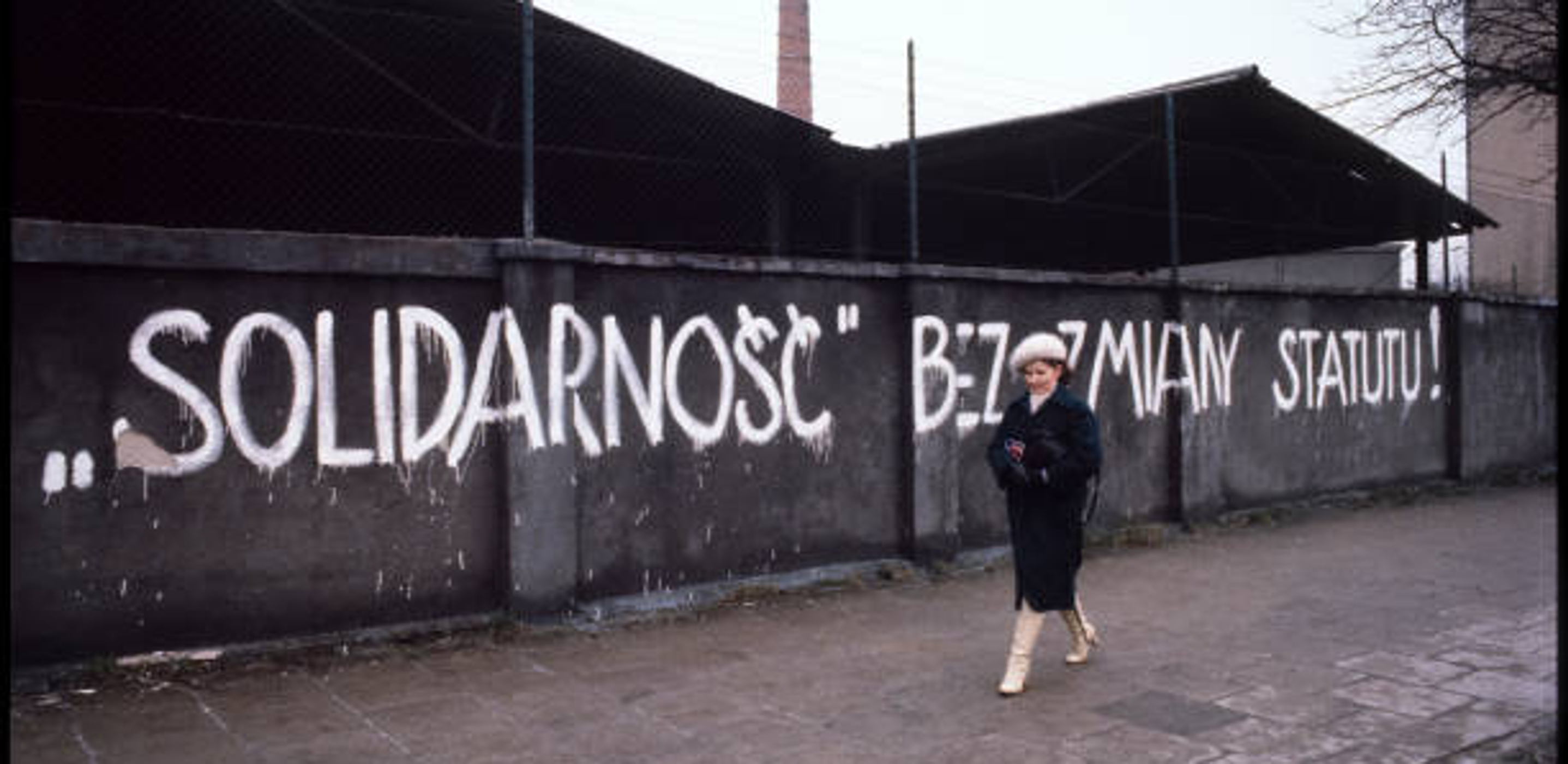
Shanghai and Gdańsk
Translator’s Introduction
The USSR endured many controversies in their relation to the rest of the Eastern Bloc in the post-war period. While the Hungarian Uprising in 1956 and the Prague Spring in 1968 are the first to come to mind, “the rise and subsequent suppression of Solidarność was the point of no return in the process that led to its end.”1 The events in Poland have been given less attention in comparison to the other political movements of the sixties, such as the Cultural Revolution in China and May ‘68 in France. However, Alessandro Russo connects Solidarność, or Solidarity as it’s known in English, to the same dynamic that was at the heart of the sixties: a political examination of the communist party. For Russo, “The ‘long sixties’ began in 1956, with the ‘salvoes’ of the Sino-Soviet dispute, and ended in 1981 with the coup that suppressed Solidarność in Poland.”2 Solidarity occurs at the end of the sequence of the long sixties, and it was a militant workers movement that was organizing directly against the communist party-state of the USSR.
Solidarity was connected to a long line of popular resistance in post-war Poland. The Polish People’s Republic (Polska Rzeczpospolita Ludowa or PRL) formed under the aegis of the USSR. The Polish post-war horizon was therefore always governed, or limited by, this relation of dependence and domination. This relation with the USSR also set the tone for socialism as a hostile power installed by a hereditary national enemy. There was a student uprising in 1968 and workers revolted following price increases in 1970-71, but both movements were isolated from each other. The groundwork for something like Solidarity would be laid in the late seventies. After another round of worker protests in ‘76 (again provoked by government mandated price increases), a novel political organization appeared on the stage. The formation of the Komitet Obrony Robotnikow (KOR) in September of 1976 was the first successful linkage of intellectuals and workers in the PRL and would form the basis for what would eventually emerge in Solidarity. KOR would organize aid and legal defense of rebel workers, combatting state repression and facilitating/defending labor organizing. It consisted mostly of academics, journalists, lawyers and other figures of the intelligentsia.3
In July 1980, the government again implemented broad price increases, provoking protests and strike actions in the Lenin Shipyard in Gdańsk and elsewhere. Solidarity was first recognized legally via the Gdańsk agreement of 31st August. An informal agreement between strikers in the Lenin Shipyard and the State was agreed on September 3rd (Jastrzębie agreement). The crisis undoes Edward Gierek as leader of the communist party, replaced by Stanisław Kania on September 6th. Strike action meanwhile spreads throughout the country. On September 17th, delegates from 35 different union founding committees applied for legal registration as the “Independent Self-Governing Trades Union ‘Solidarity” and the first meeting of its national co-ordinating commission (KKP) was held in Gdańsk. Solidarity was formally recognized by the supreme court on October 24th. Strike actions and protests continued to spread nationwide while negotiations between the government and solidarity were ongoing. Concessions were made by the state in a desperate bid to stave off the crisis, but the PRL finds itself in a state of virtual paralysis. Martial law (or a “state of war”) was declared by General Wojciech Jaruzelski on December 13th, 1981; Solidarity was then banned and forced to go underground. This initiates a period of clandestine organizing and vicious state repression, with many of Solidarity’s leaders arrested and imprisoned, and in some cases, beaten and tortured. The crushing of Solidarity by the USSR completed the crisis of Marxism, to reference Alain Badiou’s analysis. It was the nail in the coffin which demonstrated, once and for all, that mass movements could not coexist with communist party-states.
Solidarity was eventually re-registered and legalized on April 17th, 1989 amid Glasnost. Free elections were allowed and Solidarity won a significant number of seats in June, thus effectively co-ruling the state with the PZPR. The PRL formally dissolved and became the Republic of Poland in December of 1989. Lech Wałęsa, one of the leading figures of Solidarity, would go ahead to run and win the presidency of the new Republic in ‘91, thus presiding over Poland’s economic and social neo-liberalization.
“Shanghai and Gdańsk” compares the sequences of the Cultural Revolution and Solidarity from the vantage point of the latter. The former was a revolution within a revolution, launched with the support of Mao to mobilize mass organizations against the reigning party-state due to the fear of bourgeois degeneration, while the latter was an anti-Marxist workers’ movement against the political stranglehold of the USSR. While the sequences are different, Leibovici writes that they both share the slogan of “down with the red bourgeoisie”. The difference in Gdańsk is that the movement did not seek to split the communist party from the state, but rather aimed to snatch the worker label from the party-state itself. Or in other words, Solidarity delegitimized the party-state by seizing its very own iconography. According to Leibovici, the main novelty of Solidarity in relation to the Cultural Revolution was that the former was a politics whose tasks were not assigned to the state.
“Shanghai and Gdańsk” was published in Le Perroquet4, the periodical co-founded by Badiou and Natcha Michel, in 1983 under the name of Renée Leibovici. Leibovici is an unknown figure, and the name is likely a pseudonym, a common practice in the publications of the UCF(ml).5 Sylvain Lazarus would often write under the pseudonym of Paul Sandevince and Badiou as Georges Peyrol.
There’s a chance this article was written by Michel, Badiou or Lazarus, to name the most notable UCF(ml) members, since they all had a keen interest in the events of Poland during this period. Michel’s book, Canapé Est-Ouest, features conversations with figures in the Solidarity movement. Badiou discusses Solidarity in Can Politics Be Thought? and describes the movement as a chemically pure form of workers’ thought. Lazarus’s comments in Anthropology of the Name indicate familiarity with Solidarity and Polish workers via factory investigations — investigations which are connected to his exploration of the worker figure.6 For Lazarus, “worker” has no intrinsic political value, and the figure of the worker is only meaningful through politics. Or in other words, “‘Worker’ only makes sense within a conception of politics, because it is politics that prescribes ‘worker’ and not the other way around… ‘Worker’ alone has no political disposition of its own, and therefore does not exist as something already present for politics.”7 Additionally, the political value of the worker is dependent on its site: the factory. There are four different types of factory for Lazarus: the factory as a site of time (parliamentarianism), as a site of the state (state socialism), as a site of money (Deng’s China), and as a political site (Solidarność, workers in May ‘68, the GPCR).8 The twentieth century factory is typically a site of time or of the state, while the factory as a political site is a rupture. We could say that the factory is usually a site in exteriority, while the factory as a political site is the only time it exists in interiority.9 For Lazarus, “The Cultural Revolution, in its worker or mass phase, and the worker phase of Solidarność are, therefore, the only known alternatives to the factory as the site of the State that do not at the same time have as a register the factory as a site of time.”10
It should be noted that the publication of this article, in 1983, occurs towards the end of the UCF(ml) and prior to the establishment of l’Organisation politique (OP) in 1985. As Lazarus says, the UCF(ml) was classist11 and post-Leninist, and sought to return the question of the party to the masses (bearing the conceptual signature of Maoism).12 The OP, on the other hand, was post-classist and abandoned the party as a referent for emancipatory politics. The terminology and argumentation of “Shanghai and Gdańsk” reflects the political vocabulary of the UCF(ml).
Before presenting “Shanghai and Gdańsk”, Fracture has also chosen to include an excerpt from Joël Fallet’s Les maos de l’UCF on Solidarity. Fallet was a member of the UCF(ml) who wrote a political and intellectual history of the organization in 2021. This account is based on his own experiences and analyses, alongside interviews conducted in the mid-2010s with former members such as Badiou, Lazarus, Michel, Cecile Winter, Judith Balso, and many others. We have included a translation of an excerpt with the organization’s approach to Poland and Solidarity.
Long live a free and independent Poland! (1980–1983)13
For three years, from the Gdańsk Accords in August 1980 until early 1983, we devoted a significant amount of our time as militants to interpreting what was happening in Poland: studying press articles on the situation14, conducting on-site investigations, organizing demonstrations and specific rallies, and distributing the Solidarność newsletter and documents related to the period of the “underground society.”15
Fundamentally, the question is whether Solidarity militants’ questioning of Marxist references is a way to demarcate themselves from the Polish United Workers’ Party’s (POUP) rhetoric and its “real socialism,” or, more profoundly, a refutation of Marxism itself.
To understand our enthusiasm, I have selected a few verbatim quotes gathered during my research.
Etienne: “This is a formidable popular and national workers’ movement that is shaking the foundations of the corrupt new bureaucratic bourgeoisie.”
Joël: “For me, the Polish movement is a political shock. Not only because it is mainly made up of workers and is mostly unanimous in its opposition to a state and a party with which it does not identify. But above all because of its search, in new terms, neither borrowed from Marxism nor drawn from the language of the capitalist world, to rebuild an identity for Polish society and to build the country’s national unity. Subjectively, Poland has helped me hold on.”
The Marxist-Leninist saluting the revolt of the Polish people: “Everyone senses that something fundamental is at stake there, on the banks of the Baltic Sea: for Poland itself — and above all for its working class, with its great historical potential — but also for the entire world.”16
Barbara, 28, is a Solidarity delegate at the Foreign Trade Institute, where she works alongside 300 other people. A specialist in consumer issues, she quips humorously in perfect French: “You might as well say I’m useless, or rather, that I have nothing to do,” then continues: “Building socialism is the last utopia.” She speaks extensively about Poland's economic situation, inflation, shortages, the “queue committees” that regulate lines for rare fresh produce, Gierek’s administration in the 1970s, and Solidarity’s list of demands. She wonders: “Solidarity wants to be a union, but it stumbles over the political conditions for fulfilling its demands. The goal has not been achieved; who is capable of influencing the political conditions? Solidarity? The POUP?”.17
Alain Badiou: “We must take note of the fact that this almost chemically pure working-class political thinking has taken a stance against Marxism-Leninism. The workers’ movement itself, politically constituted through mass events, organized its thinking in a relation of radical foreignness to Marxism-Leninism. So here we have a movement which, on the one hand, seems to verify for the first time in a long time the originary hypothesis of Marxism: the existence of a specific proletarian political capacity, heterogeneous to the political capacity of the bourgeoisie; and which, on the other hand, achieves this verification only in the nominal inversion of this very hypothesis, in the element of a hostility to everything of which this hypothesis was the name, that is, Marxism. The greatest contemporary workers’ movement thus found the self-development of its political thinking only in a relation of complete exteriority to Marxism-Leninism. In my view, whatever the role may be that national constraints (the Church, etc.) played in this process, the result is that it is now universally the case that the organic link between Marxism and the social referent of the workers’ movement has been undone before our own eyes.”18
In December 1981, the UCF proposed the formation of “Poland Intervention Groups” (GIP). They remained active until 1983. There were several in France, including one in Reims. One of its militants, a Tunisian student named Majoub, stated: “I stand with the workers against the Russian-Polish military, and I support Solidarity and the resistance of the ‘underground society.’ It is a force for peace. In France, I combat the enemies of Polish workers, whether they be on the right or the left: the PS, which protests timidly, and the PCF, which approves of the presence of Brezhnev-Jaruzelski’s tanks. As one of our tracts distributed in January 1982 says: one can only defend a cause external to oneself if one has a cause of one’s own to defend!”.19
Shanghai and Gdańsk (1983)
The opening takes place in a third port city, between Shanghai and Gdańsk, with a name symbolic for our memory: the famous Putilov factories of Petrograd.
Mao launched this call during the Cultural Revolution: ‘Mind the affairs of the State’. Doesn’t Russia, more than any other country, demonstrate that this is not self-evident? The Russian people, often and diversely celebrated for their unity and historical endurance, would even suggest the idea that the stronger a people is — historically equipped with sufficient resources for national representation and a parallel economy when necessary — the more, in a sense, they are apt for politics, yet the more they endure and remain disinterested in the state. The Bolshevik Party’s organizational apparatus was built to address this contradiction that Russian workers, alongside soldiers and sailors, had forced open in 1917. If the bourgeoisie speak of the great bodies of the State, one could say even more so that the Russian workers were then, in the most literal sense, the great body of the revolution. The factories were the rallying points of the revolutionary forces; from there the workers marched, and then they disappeared — here too in the literal sense, for hardly any of the actors of 1917 remain after the civil war. It was a crucial, inaugural, almost instantaneous, and silent intervention. The Russian workers who carried out the revolution never spoke out about its meaning, its consequences, or its balance sheet.
The workers’ events in Shanghai in January 1967 and in Gdańsk in August 1980, while different in many respects, are remarkably identical in their way of relating to the October Revolution of 1917. This is how it’s shaping up. The points of reference come from before, but the political problems are new. There is never any question of 1917 itself, although in both cases the explicit aim is to find a way to fight the enemy produced and bequeathed by October. “Down with the Red Bourgeoisie” is the common slogan in Shanghai and Gdańsk. And there is something striking, and even encouraging, in the huge coincidence, in China and Poland, of mass points of view on what should be done once the initiative is taken, even though the political problematics are so different. Now or never is the time to topple (déboulonner) our manager ! is the general sentiment, and the practice is the same: without hesitation and with equal vigor here and there, we must denounce local cadres, especially factory managers, take stock of their misdeeds and embezzlements, and bring down as many of them as possible. Hence the confusion in China regarding the “seizures of power” to be reconciled with the claim that “99% of cadres are good” and the malaise of Solidarity when, after August, the slogan demanding the dismissal of enterprise managers spread throughout Poland.
This is the heart of the problem. Because henceforth, only after Lenin, the question of communist politics is no longer that of an insurmountable obstacle to cross and we will have to deal with time in an entirely new way. The time of the State’s destruction is not the time of its seizure. This necessarily means that for all workers’ politics after 1917, there is an obligation to also deal with its relation to the existing State over the long term. Moreover, if parties are necessary, it is ultimately to deal with time, and if for Lenin it was the time of insurrection, things become more complicated afterward since there are two: the time of the relationship to power and that of its negation. This is why some rightly argue that parties of a new type are needed. One could further say that when Mao explains that contradictions within the people and antagonistic contradictions call for different methods of resolution, and that one must know how to distinguish the space of one from the other, one should add that they do not occur in the same time, and that precisely the whole problem, or the whole art, of communist politics according to Lenin is knowing how to determine at every moment which of these times is principal and decides the overall configuration. One could further say that politics today is about knowing how to master the relationship between strategy and forms of consciousness.
Shanghai proclaims the Commune, while Gdańsk, under the very name of Solidarity, recalls the social figure of the 19th-century working class: dignity, strength, mutual aid, and the value of books. We can picture those to whom Marx might have addressed his pamphlets.
One simply has to follow the thread of these symmetrical references to trace in general terms the resurgence of a possible subject of communist politics — there has long since been no subject, but only a plethora of state parties of various forms, when Mao, treating Stalin at the beginning of the sixties, registered that “without a communist movement, it is very difficult to arrive at communism” — taking place along a dual path, and through the successive illumination of two demands recovered from the past. As if the frozen era of Marxism-Leninism, in order to be truly grasped, or even exceeded, had to be straddled first in one direction and then in the other, following a reverse trajectory.
In Shanghai, this would mean starting again from the Commune, that is, restoring the revolution, to make it clear this time that it is about communism and nothing else, and especially not about striking to win a new system of bonuses that would have to be defended later. January, which marks the workers’ entry into the Cultural Revolution, saw the working class split (scission) into two fronts, each comprising several hundred factory organizations. The first front supports the municipal government and local party cadres, who, much like a left wing in our own country, promised wage increases and bonuses to get the workers on their side against the Red Guards’ assault. It triggers a strike, under the slogan of wage increases, which soon brings the entire city to a halt. The second front, that of the “rebels,” supported by Yao Wenyuan and Zhang Chunqiao from Beijing, calls for the resumption of factory operations and city services, establishes its own headquarters, and proclaims the Shanghai Commune. This marks the first seizure of power by the Cultural Revolution, which Mao supports under that name.
In Gdańsk, this would mean returning to the model of the early trade unions — that is, restoring “the workers” as a possible alternative framework for society. Jadwiga Staniszkis in her book Poland’s Self-Limiting Revolution, specifically identifies the August 1980 movement as a reaction against what she calls the corporatist mode of integrating conflicts, established in the 1970s, which threatened to disintegrate Polish popular society. August is described as the transition from corporatist protest, during the first wave of strikes against rising meat prices, “the solidarity of the strikers was still based on a functional rather than a class basis”, to, “for the first time in the history of the Polish state and people, the organization of demands on a class basis against the Communist Party”. The pivotal moment came when the workers at the Lenin shipyards, having seen their demands satisfied and with no immediate reason to strike, decided to close the gates and reoccupy the shipyards “in solidarity with the other workers of Poland.” That same evening, the MKS20 was founded, which would subsequently become the sole representative of the workers in negotiations with the government.
Communist determination and the need to break through on one hand, the need for popular consistency on the other, and thus: the necessity here to press forward absolutely without pause, the necessity to ensure above all that we do not take a second step without having verified the first.
In Shanghai, the working class, which has become such through its division, to the extent that it is no longer recognizable by objective attributes, such as the work clothes that once defined it, but is instead determined by a political, and even more so ideological, purpose and activity — the working class as a viewpoint and principle. Two classes, two ideologies, two worldviews. The working class is, within the people, the principle of scission that would permit us to root out (débusquer) in every thing, no matter how far removed from the factory, no matter how minute, a communist tendency (versant). Regarding the tomato crop or the grains of rice that have fallen to the ground, communism is here and urgent.21
In Gdańsk, the working class, donning its garb, having come to define itself, to represent itself in all its attributes, and to name its spokespeople, establishing non-division as law and the refusal of ideology as a rule, ensuring above all its symbolic role. The worker is, within the people, the principle of resistance and permanence, as exemplified by the resistance assumed by miners after the declaration of a state of war, and the role of banners and factory helmets in the demonstrations. In Poland, it is no longer a matter of splitting the State or the Communist Party, but of snatching the use of the name “worker” and restoring it in front of them.
Shanghai proclaimed the Commune and then immediately renounced the term, after a debate among the rebels established that “we always need a party” — that is to say, communism is not for today. We must emphasize the heroic character of the Cultural Revolution. It is heroic to advance voluntarily, to carry out a revolution with no fixed end date. Mao said it again and again: there will need to be several Cultural Revolutions. What, then, must this one accomplish? The failure of the Cultural Revolution, which we rightly speak of and take as our starting point, lies not in Deng Xiaoping’s return to power, but in its failure to produce its own specific criteria for failure or success. We can say after the fact that we should have renounced the state and the majority, in a sense leaving room for Deng even as we designated his kind as the target of power seizures, in order to win the organized emergence of a politics not assigned to the state. We know the total absence of interest in this kind of reconstruction. The contradiction between the stated thesis that “it will take several cultural revolutions,” “it will take the efforts of several generations,” “the development of capitalist factors is inevitable in China; we can only limit bourgeois rights,” and the determination to cling to “establishing the dictatorship of the proletariat everywhere” and “ensuring that China never becomes revisionist,” while also maintaining the requirement to “make China a powerful country”, results in the weakening of the internal struggles (des luttes d’appareil) we are familiar with, but also in these astonishing final directives from a movement that stirred millions of people to “read books,” “study,” and “think carefully.”
Chinese workers were specifically tasked with carrying this fantasy (chimère). Their mission, in a sense, was to be that arrow perpetually in motion toward an absent target (aucune cible) — a target that is perpetually identical and renewed. They never ceased to rush, to act as quickly as possible, to consummate communism immediately. After the January events in Shanghai, groups of worker envoys were sent everywhere to help arouse and establish the first “communist reforms” in history (consciously seeking to resolve the three major contradictions). There was the invention of the communist political tactic of the workers’ demonstration to end the clashes at Tsinghua University, which removed the State, specifically the army, from intervening in a civil conflict, making it a question of intra-popular politics. And then the cycle was completed in Shanghai, where, in response to the directive to study and read, workers’ philosophy study groups in the years 1974–75 were ultimately held up as an example.
Gdańsk came after the impasse of the Cultural Revolution. For the first time, a radical choice for a politics not assigned to the State was assumed. “We have made it a habit to act on society rather than on power.”22 This choice is, of course, based on previous experience of the impossibility of acting on power, in the specific need in Poland to “build unofficial structures in an official manner, but on the margins of all official structures.” But this is true of all new developments. Prior to the strikes, this gave rise to what might be called a new conception of political work:
We didn’t create a program invented from scratch by a small group; we presented our opinions and conceptions to those who wanted to discuss them and had the courage to do so... We didn’t keep a file of supporters... Our friends, as well as our enemies, suggest that the WZZ23 have what they call a line, a guiding principle. After some reflection, I have arrived at the conclusion that something of this type actually exists... In whole (en gros), our guiding principles have remained unchanged to this day... Independence, publicizing our actions, and refusing to promise the impossible in a given situation, these are all principles that we want to realize within Solidarity... Our differences do not lie in the programme because… we had a programme regarding the union’s tasks and its structure, but we had no overall programme… This absence was also, in a certain sense, inscribed in our programme… This conception, which we called independent and unofficial, has proven its worth.24
When, after the strike committee had produced the concept and established itself as the representative facing the state during the Gdańsk negotiations (with the 21-point list of demands, which concerned the country’s general interest and the ensemble of its social forces), society effectively became an organized force, this choice to “act upon society rather than upon power” could certainly be called a line. This is seen very clearly throughout the declaration of a state of war, where the choice is made not to allow the state to impose the time of the confrontation, and to stick to a line that places in the position of command, regarding what must decide the rhythm of things, the awareness that “society” has at any given moment. Politics consists of developing behavioral rules in the factories, developing the underground society, granting full importance to investigations and debates, and dealing with the subjective problem of fear: in short, there is here a politics of forms of consciousness. Provided, however, that this is indeed a politics, one that is presented as such to those who formulate it, that is, provided there remains at least the ambition to articulate a strategic point of view regarding the relationship to the state. It remains to be seen whether this is the case, or whether it amounts to an immobility that falls below this level, within a unilateral point of view of “maintaining society”, a perspective that is, moreover, presented as a mere effect of exterior constraints, and not as a choice of the moment, as “self-limitation.”
Those who believe that the only option is to defend society indefinitely for lack of a better alternative point to geopolitical constraints (it is rightly a topic that has long been taboo). One could say that an agreement is beginning to emerge on the fact that, in Poland, politics boils down to whether or not to address the national question. But those who have spoken of strategy up to now have most often done so in an old, classical Leninist mode. There is a kind of drawn-out opposition between classicism and despair, which fails to account for the political novelty that has emerged since August 1980. It is the exceeding (dépassement) of this opposition that would signify that the shift in terrain, unachieved by the Cultural Revolution, has been accomplished.
This means that the new must be named in order to be really achieved. We need new criteria for failure and success. Otherwise, we note that the working class, which produces and bears the burden of political novelty for a time, in China as in Poland, gradually finds itself frozen into a representative, ideological, or symbolic role — a timeless role. This brings us full circle to the reflection that time is properly a matter for the party, and that therefore, for the working class to remain political, there must be a dialectic between the working class and the party, whatever its renewed form may be.
It is worth noting, moreover, that the debate over politics and strategy, which first remained shrouded in great uncertainty in Poland regarding the use of the term “self-managed society” to describe this new phenomenon, has somewhat crystallized since then around the question of whether the demonstrations during the state of war period were excessively symbolic or not, and thus whether they were merely reactive or truly in fidelity to the line of independence.
Seeing the decisive importance of reflecting on the very concept of politics, we can conclude, given where things stand in Poland, that it is worth knowing that the Chinese, embracing the old armor, have mounted an assault on the heavens and are now occupied with patiently charting new paths on earth.
Translated by Cam West
Notes
-
Alessandro Russo, “The Sixties and Us” in The Idea of Communism, (London: Verso, 2016), 157.
↩ -
Russo, “The Sixties and Us”, 146.
↩ -
KOR disbanded in 1981 having considered its main objectives achieved, seeing the mass trade union movement as a more effective vehicle. In its final years it was far less active, issuing fewer statements and meetings. See: Anthony Kemp-Welch, The Birth of Solidarity: The Gdansk Negotiations, 1980, (New York: Macmillan, 1983), 278.
↩ -
It was published in issue number 29-30.
↩ -
The UCF(ml) was an organization founded in 1969 by Sylvain Lazarus and Natacha Michel. Michel discusses the organization’s founding in Roman de la politique, published in 2020.
↩ -
Sylvain Lazarus, Anthropology of the Name, translated by Gila Walker (Seagull, 2015), 46-47. He says, “The investigation of the figure of the worker, for its part, requires a worker anthropology and a study of the factory. This I undertook in several locations on several occasions: in the transit authority (RATP) depots in Paris in 1968; in the Chausson de Reims factories in 1970; in the Coder factories in Marseilles, during the Renault-Billancourt strikes in 1973; on the construction site in Fos-sur-Mer the same year, where I worked for a time as an electrical fitter; in factories in Portugal in 1973; again at Renault-Billancourt in 1975; with the workers of Solidarity in Poland in 1981; at Talbot-Poissy in 1984; at Renault-Billancourt in 1985; in Canton in 1989; in some mines and rolling mills in the GDR, Czechoslovakia and Poland in the spring of 1990; again in eastern Germany in 1992; and in Poland in 1993.”
↩ -
Lazarus, “May ‘68: History and Politics”, Fracture (Issue 1).
↩ -
Lazarus, Anthropology of the Name, 152-162.
↩ -
Ibid, 160.
↩ -
Ibid, 162.
↩ -
For Lazarus, classism refers to the conceptual apparatus that’s synonymous with Marxist politics — the apparatus of class, class-party, class struggle, class antagonism, etc.
↩ -
He discusses this, and the history of both organizations in “May ‘68”.
↩ -
This excerpt is from Joël Fallet, Les maos de l’UCF, (Paris: L’Harmattan, 2021), 254-257.
↩ -
The journal, The Alternative, whose first issue was published in November 1979, is a rich source of information.
↩ -
No. 31, Weekly Bulletin: Solidarity. A sequence in Polish history that led the Provisional Coordinating Committee, formed by Solidarity, to call on Poles to adopt specific social practices related to the “state of war”: “It is the sum of attitudes and actions that demonstrate independent thinking, an aptitude for organizational work, and a willingness to help people in need.”
↩ -
The Marxist-Leninist (N. 45), September-October 1980. Article: Long live a free and independent Poland!
↩ -
Published in the book by Natacha Michel, Canapé Est-Ouest. This is a literary work that offers a subtle way of apprehending a specific historical situation. It teaches us a great deal about the art of investigation, because this novel, through conversations rendered with literary skill, offers interesting interpretive insights into what is happening in that country. See also MOTEL Jean Yves, Scènes de grève en Pologne.
↩ -
Translator’s note: Fallet quotes Badiou’s Can Politics be Thought?. We have included the version of the quote as translated by Bruno Bosteels in the English edition of the book (Durham: Duke University Press, 2018), 57.
↩ -
Reconstructed from the shared memories of Etienne, Joël, and Alain.
↩ -
Translator’s note: The MKS refers to the Inter-Enterprise Strike Committee formed in Gdańsk’s Shipyard, which would eventually advance twenty-one demands, leading to the formation of Solidarity.
↩ -
Translator’s note: Leibovici is referring to how, during the Cultural Revolution, people were theorizing how to use the “Maoist dialectic” even for growing tomatoes. Badiou references this on page 149 of The Communist Hypothesis. He says, “There were not only the giant statues, the Little Red Book, the constant invocation, in any circumstances, of the Chairman, the hymns for the ‘Great Helmsman’, but there was also a widespread and unprecedented one-sidedness to the references, as though Mao's writings and speeches could suffice for all occasions, even when it is a question of growing tomatoes or deciding on the use (or not) of the piano in symphonic orchestras.” Badiou adds in the footnote: “The examples are real, and have given rise to articles translated into French in the magazine Pekin Informations. There we learn how the Maoist dialectic allows one to grow tomatoes, or how to find the right line in terms of the use of the piano in symphonic music in China.”
↩ -
Joanna Duda Gwiazda, on the activities of the Committee for the Creation of Free Trade Unions prior to August 1980.
↩ -
Translator’s note: this is an acronym that means Wolne Związki Zawodowe (Free Trade Unions).
↩ -
Joanna Duda Gwiazda, ibid.
↩