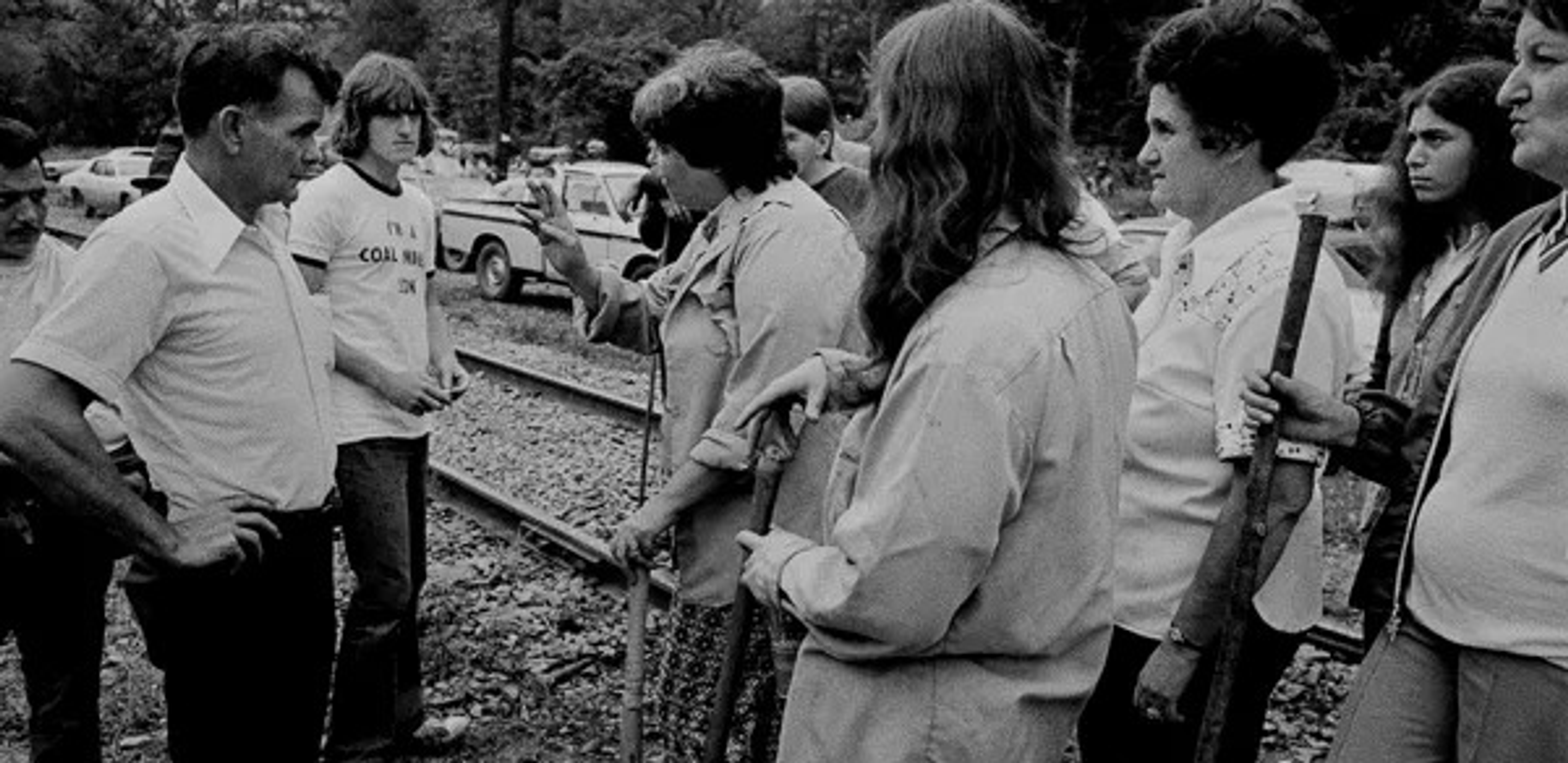
A Film: Harlan County, USA
Translator’s Introduction
This year marks the 50th anniversary of the release of Harlan County, USA, the classic documentary about the 1973 Brookside strike and the prolonged struggle of Eastern Kentucky mine workers against a subsidiary of Duke Power Company (now Duke Energy) for the right to form a United Mine Workers (UMWA) local. The film has practically become a rite of passage for those interested in left history and activism, shown internationally in college classes and organizing meetings alike. Harlan County is not only a cornerstone of what Madeleine Seidel calls the “radical Southern labor film tradition,” but a critical record and weapon in the international archives of class struggle. It is a document traversed by both a practice of political filmmaking that incisively assembles sound and image and the sheer force of community-based class power. To celebrate, we offer a translation of a 1978 review of the film by Natacha Michel which appeared in an issue of Le Marxiste-Léniniste, the main publication of the Union des communistes de France marxiste-léniniste, the French Maoist group which included among others Alain Badiou, Sylvain Lazarus, Catherine Quiminal, and Cécile Winter.
Why read this review of a film that has had countless words devoted to it already? We are, after all, as far removed in time from the Brookside strike as those workers were from the “Bloody Harlan” strikers of 1931-32. First, Harlan County offers a lens into a political struggle that departed from the facts of the situation, into which the filmmakers threw themselves with full commitment. It was a strike that had its ups and downs, ebbs and flows, but ultimately held together through the fortitude and courage of its protagonists.1 What we see via the camera is a political subjectivity coming into being, albeit a subjectivity shot through with contingency and risk. Second, it is a cross-section of a longer collective process, extending from the 1960s into the 1980s, where the sustained self-activity of miners and ordinary people in Appalachia against the prevailing balance of forces led to a powerful array of new organizing projects which researched and resisted exploitation on the job, the paired phenomena of exposure to occupational and social hazards and environmental destruction, and other forms of domination.2 Regional shifts in the extractive economy and state development aid from the 1930s on, as well as fierce battles within workers’ institutions like the UMWA, had restructured a whole entrenched system of corporate power and its coercive apparatuses.3 The new conditions created opportunities and dilemmas for action in the mines and the surrounding communities. Third, the review sheds light on the international circulation of workers’ struggles in this period, down to their granular practices and shared worlds of reference.
Michel is a capable interpreter of the lasting power of the Brookside struggle, in its triumphs, difficulties, and ambivalences. Her work with the UCFml and the Organisation Politique revolved around identifying, interpreting, and supporting instances of workers’ insurgence.4 In the March 1995 issue of La Distance politique, the bulletin of the Organisation Politique edited by Michel for many years, the group reflected on the one-month strike by rolling stock manufacturing workers in Bourogne from October to November of the previous year. “A strike is an important thing, a serious thing,” they begin, which involves “an extreme subjective mobilization.” Participants rush to catch up with every detail, to be present at every action, to constantly discuss and strategize. This “attention to everything going on” during the work stoppage and the exhaustion that accompanies it prevents, however, a “cold-blooded reexamination” of what has actually taken place. Strikes are a “pell-mell” assemblage, whose complexity should be analyzed from the perspective of the “forms of consciousness, statements, and practices” they contain.
For Organisation politique militants, what matters most in strikes is that they are “political situations...in which workers have declared something.”5 But what is that something declared? A declaration is neither a slogan nor a demand – it is an assertion which is also a thought, and at minimum poses a “new principle in the situation,” a capacity that did not exist before. A declaration “says what is in view of what might come; it proposes something that is both different from what is, and possible.” It “indicates how to articulate the principles of this different and possible something [quelque chose].” It consists of a “statement” [énoncé] that enables political actors – in this case, striking workers – to move past the initial opening of revolt toward an independent process of thinking and action. A declaration, then, is a sort of crystallization of the strike’s simultaneous power and precariousness.
Strikes can crack open the established order of facts. Declarations from Harlan County and the Brookside strike might be found in the first leaflets put out about the strike, or first issue of the Harlan Labor News, the workers’ voicepiece in the conflict: “Brookside workers have a right to pick who presents them…a right to have a say in their own affairs”; “We are on the side of workers and people fighting for a decent life and their basic rights.”6 Or, in a scene included in the film, when Bessie Cornett testifies before the Harlan County court – a court identified by strikers and supporters as complicit with the mine operators – after being arrested on the picket line and sentenced to 60 days in jail:
I knew we weren’t going to get any justice. You say the laws are made for us. The laws are not made for the working people in this county…I knew what I was doing at Brookside because that’s what I wanted to do. For once I was able to take the offensive instead of coming down here to take a step backward to try to defend what we did. What we did was right and we all know that.7
These enunciations are the evidential trails that follow in the wake of a strike – the deposits of a collective practice, an orientation of thinking.8 They demonstrate that “[i]f you stop work, something must have been thought. Something must have been thought that was different from the boss or the union.” The opposing side in the struggle will ceaselessly attempt to paper over or cover the declarations, turning the search for them into a type of militant inquiry.
Harlan County served as a juncture for currents of politics that traced a new path forward in the workers’ movement. It was a flashpoint of the rank-and-file rebellion in the United Mine Workers of America that swept through the 1960s and 1970s; its timing came on the precipice of major social and economic transformations in Appalachia, as the environmental and health impacts of the region’s extractive industries sparked public protest and debate; a “culture of solidarity” emerged whose force broke through in the film’s many spaces: in living rooms, multipurpose centers, and holler gravel roads.9 The strikers and their comrades waged a political battle that displayed their capacities for militance, courage, and organizational inventiveness in the face of overwhelming odds.
The health and safety costs of coal mining work are front and center in the film: there are moving sequences on both the devastating effects of black lung disease on families’ lives and the constant threat of mine accidents. Brookside miners were well aware of the efforts of the Black Lung Association for workers’ compensation and the walkouts in West Virginia in 1969 over the issue (the “Black Lung Strikes”), which Jim Green contends to be the “most important political strike in modern labor history.”10 The strikers wanted a contract with the UMWA specifically because they wanted adequate protection from the innate hazards of the various methods of mining work itself, and a UMWA contract would guarantee the enforcement of safety regulations through oversight committees and hospitalization benefits.11 The spirited mass pickets at Brookside and Highsplint find immediate antecedents in the roving picket movement among unemployed miners in Eastern Kentucky during the early-mid 1960s, a crucial portion of whom sought to force Bituminous Coal Operators’ Association to pay full royalties toward union hospitalization and retirement funds. Some smaller operators had avoided the payment and essentially disenfranchised former or disabled miners from the fund by cutting sweetheart deals with the UMWA.12 This fight can be placed in continuity with the contemporaneous important struggles waged by migrant workers in France against lead poisoning in refineries or petrochemical workers in Porto Marghera against the “noxiousness” of capitalist production.13 These were militant occupational health movements that challenged employer neglect head-on and demanded protection from evident health hazards and employer neglect. From the publicization of mine disasters to detailed reports on the constant exposure to toxic dust, gases, and other material in the workplace, these workers and their allies articulated a basic “right to breathe” which questioned the very logics of their industries and came about through extraordinary projects of self-organization.14
The film calls upon clear threads of memory, both nostalgic and politically charged, of miners’ struggles in Harlan throughout. The film hints at an unalloyed transmission between the 1930s battles miners waged against the operators (the Harlan County “War”) and 1973 in Brookside. But as E. Anne Kaplan notes, there is a situated or partisan aspect to the project that cannot be easily discounted.15 Kopple’s film crew becomes part of the unfolding political sequence. We see this aspect break through in the remarkable continuous shot on the picket line where members of the Women’s Club speak to the sheriff and hand him the warrant for the gun thug Basil Collins’s arrest: we follow Kopple and the camera operator as the sheriff walks across the road to Collins’s car – he is dumbfounded, defeated, and tells the film crew to clear out, as if the strikers were right in his face. Kaplan writes about the intimate perspective through which the viewer is able to watch the strikers’ meetings, seeing the disagreements play out and strategies develop.16 Quick cuts allow many voices to be heard, while the camera sometimes lingers for particularly poignant or affective moments. Indeed Harlan echoes other innovative approaches to communist film production which sought to link political inquiry and filming – the 16 mm camera and the Nagra recorder were the instruments of enquête.17 Kopple is able to shed light on what Dziga Vertov called the “thinking of the ‘living person’...of several and even many people.”18
As Christian Metz acknowledged in an interview, Harlan County was a very popular film in France, staying in theaters in Paris for at least three months.19 The long 1968, a sequence of worker insubordination and protests by a range of social actors, provided an open context of reception for reconsiderations of US labor history in the hotspots of revolt across Western Europe.20 Michel’s text thus provides an opportunity to examine the internationalist dimensions of the Brookside strike. The very tactics and cultural practices of the Harlan strikers displayed this transnational aspect. In his sweeping 2010 oral history, They Say in Harlan County, Alessandro Portelli describes how one method miners used to disable trucks carrying scabs was to weld two pieces of metal together (called “bobjacks”) and surreptitiously place them under the tires. These devices were basically the “same weapon” that Italian Resistance partisans deployed in Rome to cut off German supply lines during the Battles of Anzio and Cassino.21 And the mining community songs, which provide the beating heart of the film, echoed with songs sung across the Atlantic during the 1974 Welsh miners’ strike.22
In its concision, Michel’s review excavates these features, marking a genuine sequence of politics. It is attentive to the statements of a set of workers in struggle. She pieces together a carefully wired circuitry of listening – a willingness to see something novel in the combat of older and younger mining families alongside their allies, even with all their accumulated history, even with their entrenched political reference points. The subjects of the film speak in the language of union institutions and their enemies, of sedimented, deep-rooted conflicts rolling through once again. Yet this very exertion produces something beyond an anachronistic fidelity to contests long since decided.
A Film: Harlan County, USA23
Harlan County, USA is far from a maligned film. Award-winning, it has received an Oscar, been recognized, tolerated, by an America where the right to say anything in no way intersects with the right to do anything; the film stood out with the power of a classic work, a capacity to show the people, not only in its multitude, its strength, but its crucial reality.
The story of a strike in an early 20th-century mining town in the US, the story of miners’ wives, Harlan County is a film that shows all that: these dimensions, these segments – because it is about History, that each moment pushes and pulls on its links to History, we have fragments before our eyes – without a cold découpage whose constitution by sight and sound, through the objective proximity of inquirer and inquiry, generally cuts down the power in the gray corridor of a forgettable vision. This is not a documentary film about which you would say afterward: “here is another slice of present-day reality, an objective or committed perspective on a strike.”
Three Theses
A film with three theses, and a moment. The three theses: the American proletariat has a history; the strike is the affair of the whole people, and the women [in the film] are those who transmit [porter] the viewpoint of the people; the struggle against capitalism is indefinite. Theses of unequal weight. A moment: unforgettable. This moment, which we will discuss, forever sears the consciousness with a red-hot iron. Never after having seen it will one forget it. And this moment, lodged at the crux of the film, unbalances the realist order and acts upon the division in us of very intimate ideas which we hardly talk about: misfortune, sadness.
The Other America
Three theses. The first: the other America, that of the proletariat, of misery and oppression. Against this America, which we are constantly reminded is “modern,” against a working class presented to us as silent and well-off, there are the people of Harlan County. Impoverished miners, mines that are comparable to those of 19th century Europe, dangerous, deadly, scandalously assembled in order to extract the maximum profit with the human, the worker left to pay the costs. The American proletarian with their different manner of speaking, their accent, their shacks without running water. And all this is not the exceptional cesspit of a marginal misery, but the daily life for 150 years for this whole part of America. The proletarian people are in struggle. Another history corresponds to this America: the great armed strikes of the 1930s, deaths, hatred, class consciousness. Class consciousness, Marxist revolutionary consciousness, whose vanquished history is killed off beginning with the Second World War, the imperialist sacred union, the Cold War. It is this history that the people of Harlan County proclaim to be true, existing, and in living memory: old miners with diminished lungs who sing laments and blues about revolt, sing about the partisans of this other America, where the lung, diseased from the mine, finds its survival and victory against the bosses. Another America, another power [force]. The exceptional presence in US films of the history of the people, of communism, of the memory that survives, because it will doubtless have the chance to live again.
The Women
But that accent of the people, and this is the second thesis, is brought to life and actualized by women. The women are the strike, adjacent to the town, the state, the police, the link of the people [lien du peuple]. Women never seen, lively, complex, fortifying their strength, their humor, their recollections, their debates, their tenacity, in order to make the strike that has been launched a strike of the people. Women never seen, impoverished women, disfigured and strengthened by a hard life: worn-out, “bruised,” but not defeated, turning around their history like a weapon, through which passes a spirit, a proletarian life-force that sweeps away the model of femininity so in vogue. The life in them is beauty itself, gravity: their grace. Meanwhile their vivacity, their will to prevail, to overcome, displays more brilliantly than anything around the imposing mass of their body, the American curls from their rollers, their gaunt faces. A point of rupture, a tearing of the fabric of civilizational conventions, these women of the people carry in them, beyond their will to rally the town to the picket lines, beyond the viewpoint of the people, the tangible motif of a different path, a different life. Through their debates, sites of intensity where the document becomes a crisis, a crossroads, it is the internal life of the people in its capacity to be other [à être autre] that is posed.
The Unduly Eternal Enemy
Opposed to them is the enemy: the bosses, the scabs, the armed thugs, the union of gangsters, the assassins, the exploiters. The secular, eternal, and (here the film is lacking) indestructible enemy. For despite what the women’s viewpoint transmits about something other, about an irreversible difference, for the film, violent, this other vision of things only feeds off the endless existence of the bosses. Indefinite struggles as well from which nothing seems to come to provide a definitive victory, a term based on the destruction of the adversary – an absence of the idea of the destruction of the enemy. The filmmakers, obviously sympathetic to the indefinite and identical struggle against the immortal boss, develop sequence-by-sequence a contestable political outlook.24
The other force, the alternative, they have irrevocably shown, despite themselves. It is the power of the people in its women, its men, its history.
A history that is never abstract: an unforgettable moment. A moment where a woman, her beautiful face emaciated, as a detour from a remark on a completely different topic, traces the emblazoned [enflammer] path of her own history: “I never could go to school,” she says almost randomly, “we didn’t have any money, any clothes.”25 And upon these words her prior sadness burns, her revolt, the oppression she has experienced and that everyone has experienced, that of a life wrenched away by capital. And we, revolutionary spectators, know in this brief moment that the misfortune caused by exploitation, by oppression, the revolution will destroy it, that revolt will combat it and divide it, but that this sadness, this cry delivered almost from the side in the impassioned modesty of this woman, will require the whole dictatorship of the proletariat, the whole of socialism and its struggles to abolish it.
Translated by Patrick King
Notes
See Ludivic Batigny and Boris Gobille, “L’expérience sensible du politique: Protagonisme et antagonisme en mai–juin 1968,” French Historical Studies, 41, no. 2 (2018): 275-303.
↩See Fighting Back in Appalachia: Traditions of Resistance and Change, ed. Stephen L. Fisher (Temple University Press, 1993). The Peoples Appalachian Research Collective, spearheaded by figures like Keith Dix, Robb Burlage, Rick Diehl, and Mike Maloney, among many others, looms large here. There was a true confluence of different streams of activism and research in the 1960s and 70s across the broader region: See John Gaventa, “Appalachian Studies from and for Social Change,” Appalachian Journal 5, no. 1 (Autumn 1977): 23-30, and the rest of the contributions to the issue, and follow-ups in the Winter-Spring 1982 issue of Appalachian Journal, “Assessing Appalachian Studies”; Steve Fisher and Jim Fisher, “Models for Furthering Revolutionary Praxis in Appalachia,” Appalachian Journal 6, no. 3 (Spring 1977): 171-94 (a very extensive bibliography); Thomas E. Wagner, Phillip J. Obermiller, Melinda J. Wagner, and Mike Maloney, “Fifty Years of Appalachian Advocacy: An Interview with Mike Maloney,” Appalachian Journal 40, nos. 3-4 (Spring/Summer 2013): 174-218. For recent reflections, see Studying Appalachian Studies: Making the Path by Walking, eds. Chad Berry, Phillip J. Obermiller, and Shaunna L. Scott (University of Illinois Press, 2015); and the important book by Shaun Slifer, So Much to be Angry About: Appalachian Movement Press and Radical DIY Publishing, 1969-1979 (West Virginia University Press, 2021).
↩See John Gaventa, Power and Powerlessness: Quiescence and Rebellion in an Appalachian Valley (Clarendon Press, 1980); Robyn Muncy, “Coal-Fired Reforms: Sociai Citizenship, Dissident Miners, and the Great Society,” The Journal of American History 96, no. 1 (Jun., 2009): 72-98; David E. Whisnant, Modernizing the Mountaineer: People, Power, and Planning in Appalachia, second edition (University of Tennessee Press, 1994).
↩Natacha Michel, Le roman de la politique (Paris: La Fabrique, 2020).
↩These and subsequent quotations from the Organisation politique can be found in “Sur la grève des ouvriers d’EGT-Alsthom,” La distance politique 13 (March 1995): 1-16.
↩See Lynda Ann Ewen, Which Side Are You On? The Brookside Mine Strike in Harlan County. Kentucky, 1973-1974 (Vanguard Books, 1979), 24, 110.
↩Cornett would become a long-time member of the Communist Labor Party and the League of Revolutionaries for a New America.
↩See for instance, Sally Ward Maggard, “Women's Participation in the Brookside Coal Strike: Militance, Class, and Gender in Appalachia,” Frontiers: A Journal of Women Studies 9, no. 3 (1987): 16-21. A militant in the sans-papiers movement once described the Organisation politique’s politics as a “practice that thinks itself and a thought that practices itself, in which political tasks…are moments to test the political capacity of each one of us and also the strength of our political fight.” Tout: Journal du Rassemblement des Collectifs des ouvriers sans-papiers des foyers et de l”Organisation politique, no. 6 (March 2002): 12.
↩Rick Fantasia, Cultures of Solidarity: Consciousness, Action, and Contemporary American Workers (UC Press, 1989). For different perspectives on this rebellion, see Paul J. Nyden, “An Internal Colony: Labor Conflict and Capitalism in Appalachian Coal,” Insurgent Sociologist, 8, no. 4 (January 1979): 33-43; “Miners, ‘Their’ Union, and Capital,” Science & Society 34, no. 2 (Summer, 1970): 194-223; “Rank-and-File Organizations in the United Mine Workers of America,” Insurgent Sociologist, 8, nos. 2-3 (October 1978): 25-39; “Rank-and-File Rebellions in the Coalfields, 1964-80,” Monthly Review, 58, no. 10 (March 2007); William Cleaver, “Wildcats in the Appalachian Coal FIelds,” Zerowork 1 (December 1975): 114-27; Mike Ely, “Ambush at Keystone No. 1,” Kasama Project, July 2009, and the excellent interview with Cosmonaut Magazine, “Communists and the Miners’ Upsurge with Mike Ely,” August 2021; Judson Abraham, “Mao in the Mines: An Anti-Systemic View of New Communist Movement Activity in the Appalachian Coalfields, 1962-1978,” MA Thesis, Virginia Tech University, 2014.
↩James Green, “Holding the Line: Miners’ Militancy and the Strike of 1978,” Workers’ Struggles, Past and Present: A “Radical America” Reader (Temple University Press, 1983), 330; Trish Kahle, “‘A Woman’s Place Is in the UMWA’: Women Miners and the Struggle for a Democratic Union in Western Pennsylvania, 1973–1979,” Labor 13, no. 1 (2016): 41–63.
↩Nyden has argued that the timing of this push for health and safety guarantees on the job and the return of many young people from the Vietnam War into the mines in a conjuncture of rising coal dependency (due to energy crisis) was not coincidental: “Men who escaped death or injury in Vietnam had little inclination to be maimed or killed in a coal mine once they returned home.” Paul J. Nyden, “Rank-and-File Movements in the United Mine Workers of America,” Early 1960s-Early 1980s,” in Rebel Rank and File: Labor Militancy and Revolt from Below During the Long 1970s, eds. Aaron Brenner, Robert Brenner and Cal Winslow (Verso, 2010): 173-97.
↩Kate Black, “The Roving Picket Movement and the Appalachian Committee for Full Employment, 1959-1965: A Narrative,” Journal of the Appalachian Studies Association 2 (1990): 110-27
↩On Penarroya, see Laure Pitti, “Penarroya 1971-1979: ‘Notre santé n'est pas à vendre!,’” Plein Droit 83, no. 4 (2009): 36-40, “The Struggle for Lead Poisoning Recognition in the Workplace in France : the 1970s Turning Point,” in At Work in the World: Proceedings of the Fourth International Conference on the History of Occupational and Environmental Health, ed. Paul D. Blanc and Brian Dolan (University of California Medical Humanities Press, 2012), 172-175; Burleigh Hendrickson, “Imperial Fragments and Transnational Activism: 1968(s) in Tunisia, France, and Senegal,” PhD thesis, Northeastern University, 2013, 237-43; the texts from the Cahiers de Mai have been translated as a series here. For a rich account of the Porto Marghera experience, its central place in the Hot Autumn struggles, the history of Italian operaismo, and the enduring legacy of its political forms and militant networks, see Manuela Pellarin’s 2004 documentary The Last Firebrands and its accompanying pamphlet.
↩See Bue Rübner Hansen, “The Interest of Breathing: Towards a Theory of Ecological Interest Formation,” Crisis & Critique 7, no. 3 (2020): 109-37.
↩E. Anne Kaplan, “Theory and Practice of the Realist Documentary,” in “Show Us Life”: Toward a History and Aesthetics of the Committed Documentary, ed. Thomas Waugh *Metuchen, NJ: Scarecrow Press, 1984), 212-222. Kopple’s film sparked relevant debates over political filmmaking and questions of authorial intent, narrative structure, and documentary’s ability to convey direct experience and historical continuities. See Noel King, “Recent ‘Political Documentary’: Notes on Union Maids and Harlan County, USA, Screen 22, no. 2 (1981): 7-18. Anne Lewis, the assistant producer and camera operator on the film, talked about the effect that walking to the strikers’ side of the picket line the first morning the crew arrived “in Harlan had on the trajectory of her life: It was a life-changing moment for me. It might have been for everyone else on the crew. I realized that even though I was an outsider, I had to have a direct relationship. I had to pick a side in order to function as a human being. There was no way to be objective in this situation. So that was a life-changing situation for me, and I developed a level of actual participation in that strike…So from that point on, I was on the side of working people, in particular, on the side of the folks in the Appalachian region.” Jesse Buckwalter et al. with Anne Lewis, "That Point of Human Connection": An Interview with Filmmaker Anne Lewis” Appalachian Journal 40, nos. 1-2 (Fall 2012-Winter 2013): 58-76.
↩Kaplan, “Theory and Practice of the Realist Documentary,” 217-18.
↩See Kopple’s pressing remarks in an interview with Jump Cut: “In order to achieve something or in order to win some kind of victory, you all have to be united under the same ideas or the same cause. It taught me a lot about criticism and self-criticism—that it wasn't on a personal level, that it was on a political level that depended on the survival of everybody. It also taught me what it meant to be in a life or death situation where nobody was going to help me. The only power you had came from that community, and if that community went against you, you were dead. And those are some very powerful lessons.” See too Gail Pellet, “The Making of Harlan County, USA: An Interview with Barbara Kopple,” Radical America 12, no. 2 (March-April 1977): 33-42.
↩Vertov, Kino-Eye, 156.
↩Sandy Flitterman, Bill Guynn, Roswitha Mueller, and Jacquelyn Suter “The Cinematic Apparatus as Social Institution – An Interview with Christian Metz,” in Christian Metz, Conversations with Christian Metz: Selected Interviews on FIlm Theory (1970-1991), ed. Warren Buckland and Daniel Fairfax (Amsterdam University Press, 2017), 179-204.
↩The rank-and-file upsurge of US workers throughout the 1960s and 1970s was welcomed by sympathizers and militants in France. Daniel Guerin wrote in 1968 that the “spirit of rebellion, directed almost as much against trade union leaders as the employers, shows that despite its bureaucratization, the American workers’ movement is much less of a hierarchical organization or totalitarian machine than one might have believed.” The bulletin Informations et correspondances ouvrières covered the Delano Grape Strike and the Teamsters strike of 1970, with a mention of the incredible September 1970 incident where three striking Teamsters members shot and blew up a truck carrying dynamite to a mine near Springfield, Missouri, killing the strikebreaking driver and severely damaging a large chunk of I-44. See “Texts from Comrades in the USA,” ICO 99 (November 1970): 9. Its successor publication, Échanges, which had links in the UK and the US, would publish devote a whole issue to the “changing reality” of the US labor movement in 1977, with an extended piece on the 1975-76 wildcat strikes that broke out in coal fields in several states in response to both the coal operators’ layoff schemes and the UMWA’s reticence. See “The Coal Miners’ Struggles 1975-1976,” Échanges 8 (1977): 13-16. The Cahiers de Mai, an important post-May 1968 journal and activist collective that engaged in an ongoing practice of workers’ inquiry, circulated information about struggles in different sectors, and hosted debates over political strategy, published two texts on the 1970 U.S. Postal Workers’ strike and another on the aforementioned Teamsters’ strike of the same year. “For the First Time in 196 Years, U.S. Postal Workers Defy Power” Cahiers de Mai 19 (April 1970): 25-27; “Teamsters’ Wildcat Strike Threatens Nixon, ”Cahiers de Mai 22 (July 1970): 21-22. For more on the Cahiers de Mai, see Matthieu Firmin, Les Cahiers de Mai, 1968-1974, entre journalisme et syndicalisme, Master’s thesis, Univ. Paris 1 CRHMSS, 1999; Donald Reid, Opening the Gates: The Lip Affair, 1968-1981 (Verso, 2018); Kristin Ross, May ‘68 and Its Afterlives (University of Chicago Press, 2002); Nicolas Hatzfeld and Cédric Lomba, “Les Cahiers de Mai: partager l’enquête pour donner la parole,” in Les enquêtes ouvrières dans l'Europe contemporaine, eds. Eric Geerkens, Nicolas Hatzfeld, Isabelle Lespinet-Moret, and Xavier Vigna (Paris: La Découverte, 2019), 151-62.
↩Alessandro Portelli, They Say in Harlan County: An Oral History (Oxford: Oxford University Press, 2011), 312-13.
↩Anne Lewis was part of a group that recorded cultural exchanges between Welsh and Appalachian miners between 1974 and 1976, eventually released in the 2015 short documentary Eyes Upon the Scale. See also the 2015 film After Coal, where Lewis observes that these cultural interactions “really documented the last generation of those communities as real mining communities.” See too David Frank, “The Country of Coal,” Labour/Le Travail 21 (1988): 233-242.
↩Natacha Michel, Le Marxiste-Léniniste, 23 (1978): 15-16.
↩Translator’s Note: Séquence has two meanings in French film vocabulary: frames or isolated camera shots, and a distinct scene extending over time. Since Harlan County is very much a movie with distinct scenes of activity, we have retained sequences over frames.
↩TN: Michel is misremembering the precise dialogue of the scene. During a contentious meeting over the declining numbers on the picket lines, Sudie Crusenberry, member of the Brookside Women’s Club, intervenes to break up a personal disagreement and redirect attention to strike organizing. Crusenberry, whose husband was injured in in a mining accident and forced to retire. Her involvement in the strike stems from a political commitment and shared experience of suffering exploitation. She then launches into an extended testimony of the difficult conditions of her early life (her father had black lung disease, and the family was evicted from Brookside mining camp when another company took over the mine) which clearly resonates with others present. She becomes visibly emotional over the course of the scene, a close-up shot of Crusenberry. The text is from the subtitles of the Criterion Collection edition of Harlan County: “It either smashed up their daddies or down with coal dust from that mines. I went to school – to age of school – I’ve got part of the sixth grade because Daddy got eight dollars and something a shift. Nothin’ to go to school on, I had to go in overalls, and pile out slate for a living after I growed up. Coal out of it and sell it. And...walk off of that mountain from that mines to school. And they’re all barned up there, not even allowed in it. I’ve got Mom’s coal oil lamps. I’ve her stove irons a-sittin’ there for ‘em to look at. And walkin’ to school and back.”
↩